


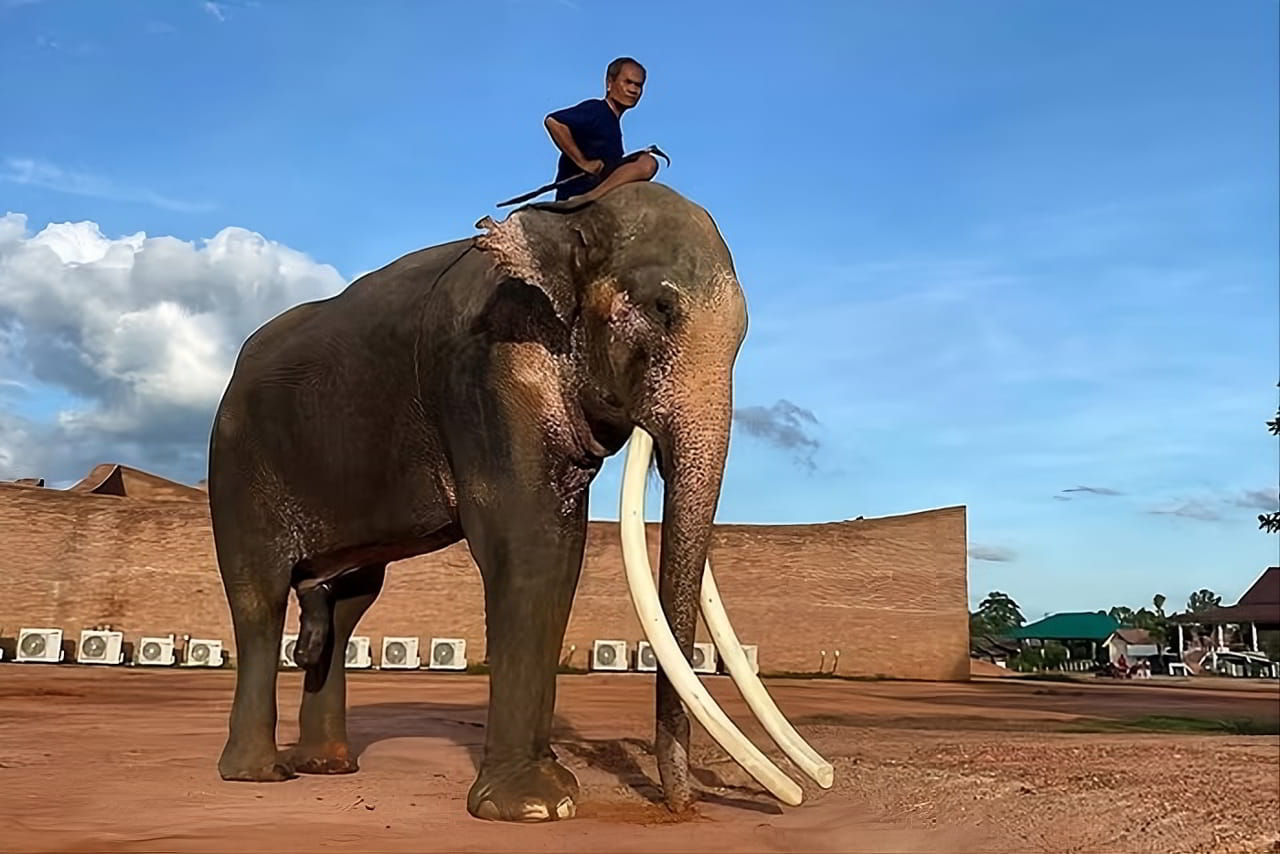
Why the Death of Elephant Plai Thong Bai Has Moved So Many Thais
Written by the editors of theo-courant.com, your reference guide to Thailand and South-East Asia - based in Bangkok, at the heart of Thai culture.

The death of Plai Thong Bai, one of Thailand’s most famous elephants, triggered an emotional wave far beyond his home province. In the elephant village of Ban Ta Klang, in Surin province, mahouts mourned the animal they sometimes called the patriarch. With his massive tusks stretching over two meters and his imposing presence, Plai Thong Bai seemed to embody an entire part of Thai history on his own.
Plai Thong Bai, the elephant who became a national symbol
Plai Thong Bai died on May 10, 2026, at the estimated age of 53. Born in Bangkok in 1973, he was widely regarded as one of the most impressive domesticated elephants in Thailand. His exceptionally long and symmetrical tusks made him famous throughout the country. Over the years, he appeared in advertising campaigns and official ceremonies.
But in Surin province, known for its Kuy mahout traditions, Plai Thong Bai represented far more than a media attraction. In some families, elephants have been raised for generations as full members of the community. Their death is often experienced as a family loss.
A few days before his passing, a monumental elephant statue in the region was damaged during a storm. Some locals interpreted it as an omen, reflecting the spiritual dimension still associated with elephants in several Thai communities.
Elephants as symbols of power and the kingdom
For centuries, elephants have occupied a central place in Southeast Asian societies. In Thailand, they were used in warfare, logging, royal ceremonies and agricultural labor.
The white elephant, an extremely rare animal, remains closely associated with the Thai monarchy and royal authority. Until 1917, a white elephant even appeared on the national flag of Siam.
In rural regions — especially among the Kuy people of Surin, the Karen communities of northern Thailand and some neighboring Lao groups — elephants were long regarded as working companions endowed with a form of spiritual intelligence. Mahouts often develop deeply personal relationships with their animals, sometimes lasting several decades.
This close bond also explains why the death of certain elephants can trigger reactions similar to those seen after the passing of public figures.
The Kuy and the Karen, two communities historically connected to elephants
The Kuy people of Surin
The Kuy — sometimes called Kuoy or Suay — mainly live in Surin province in northeastern Thailand, near the Cambodian border. For centuries, they have been renowned for their expertise in capturing, raising and training elephants.
For a long time, the Kuy worked as mahouts for Siamese kingdoms before later becoming involved in the logging industry. In Ban Ta Klang, often referred to as “the elephant village”, many families still live in close contact with elephants today.
Among the Kuy, elephants are not viewed solely as a source of income. They also carry a spiritual and family dimension. Certain animist rituals and local beliefs still give an important place to protective spirits associated with elephants.
The Karen communities of northern Thailand
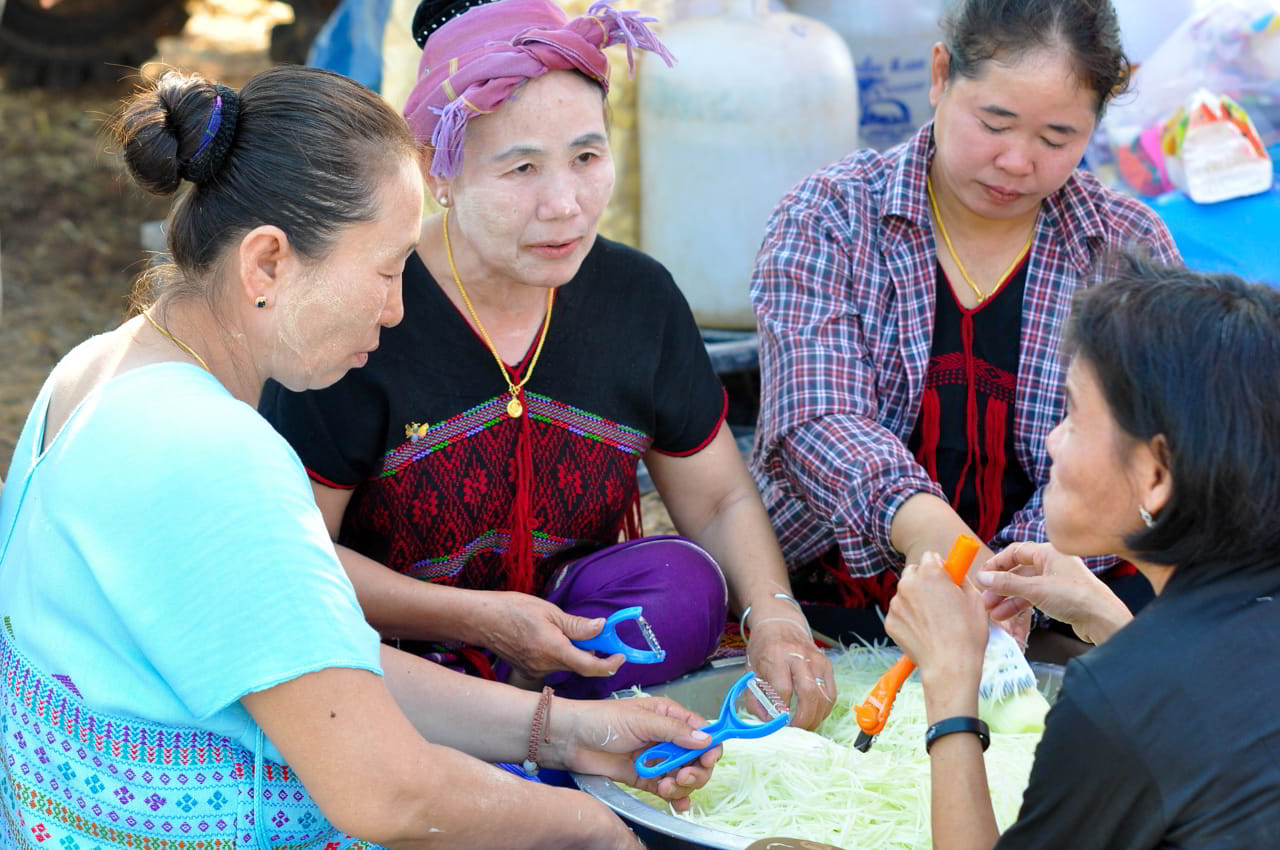
The Karen mainly live in the mountains of northern and western Thailand, particularly around Chiang Mai and Mae Hong Son. Several Karen groups developed close relationships with domesticated elephants, once used in teak logging and forest transportation.
After Thailand banned logging in 1989, many Karen families turned toward elephant-related tourism. Some elephant camps and sanctuaries in northern Thailand are now operated by Karen communities.
Contrary to the simplified image often presented through tourism, the relationship between the Karen and elephants remains complex, combining ancestral traditions, economic dependence and adaptation to international tourism.
How long do elephants live in Thailand?
Asian elephants generally live between 50 and 70 years, sometimes longer under favorable conditions. Females often live slightly longer than males, partly because males experience periods known as musth — hormonal phases that can trigger aggressive behavior and significant physical exhaustion.
In the wild, elephants rarely age without difficulty. As their teeth gradually wear down, feeding becomes more complicated, and many eventually die from malnutrition linked to old age.
In captivity, their lifespan depends heavily on living conditions:
- quality of food;
- access to water;
- workload;
- veterinary care;
- stress levels.
At 53 years old, Plai Thong Bai was therefore considered an elderly elephant, though not exceptionally old for a well-treated domesticated elephant.
From logging to elephant tourism
Until the 1980s, domesticated elephants were mainly used in Thailand’s logging industry. But after logging was banned in 1989, thousands of mahouts suddenly lost their livelihoods.
Tourism then became the primary source of income linked to elephants:
- elephant rides;
- shows;
- tourist camps;
- photo sessions;
- sanctuaries.
Chiang Mai, Phuket, Pattaya and Koh Samui all saw the emergence of camps catering to foreign visitors. For many years, these activities were widely considered normal, including by Western tourists.
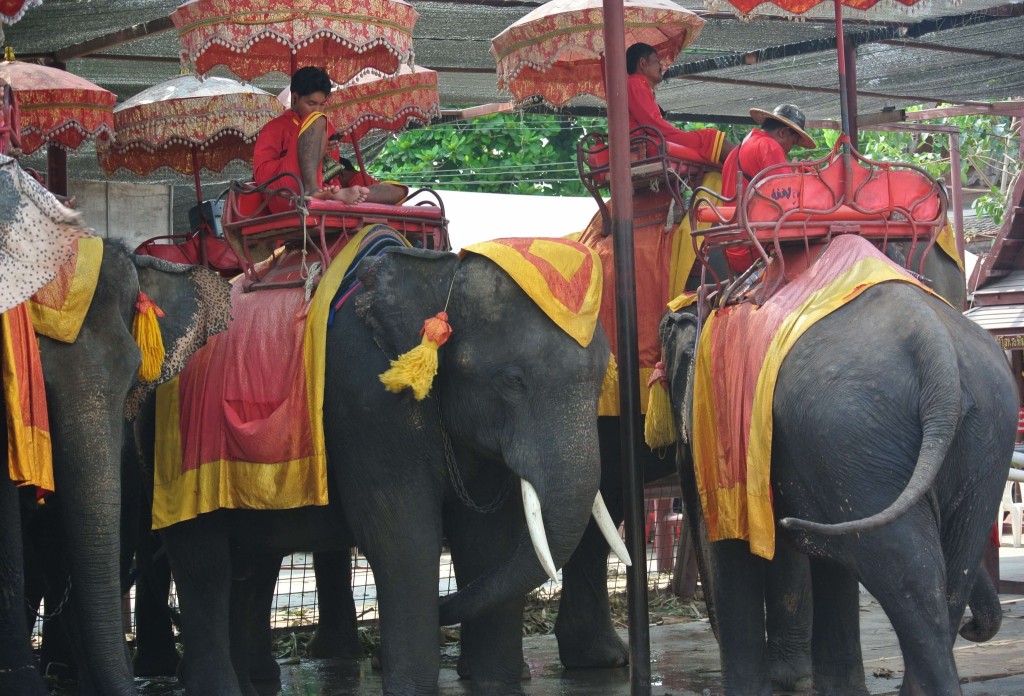
But over the past fifteen years, criticism has intensified. Several NGOs have denounced:
- training methods;
- the use of chains;
- performances;
- captivity conditions;
- the physical burden imposed on the animals.
On Reddit and social media, debates have become increasingly heated between supporters of “ethical” sanctuaries and defenders of traditional practices. Some users point out that elephants have worked alongside humans for centuries, while others criticize what they see as a tourism industry that has become purely commercial.
The limits of the “ethical sanctuary” model
In response to international criticism, many elephant camps have rebranded themselves as ethical sanctuaries. Visitors no longer ride elephants but instead participate in activities presented as more respectful:
- feeding;
- bathing;
- observation.
However, several researchers and animal welfare advocates argue that the sanctuary concept can sometimes remain ambiguous. Some establishments use the language of animal rescue while still operating primarily through tourism revenue.
Other observers also highlight an often overlooked economic reality: feeding an elephant is extremely expensive. An adult elephant can consume more than 150 kilograms of food per day. In some rural areas, tourism income remains essential for funding veterinary care and maintaining the animals.
This economic dependence makes the debate particularly complex in Thailand.
A question that goes beyond tourism alone
Ultimately, the death of Plai Thong Bai raises a broader question: what place do modern societies still want to give to animals domesticated for centuries?
In Thailand, the elephant is not merely a wild animal or a tourist attraction. It remains deeply connected to collective memory, rural traditions, popular Buddhism and national identity.
But tourism pressure, urbanization and the gradual disappearance of forests have profoundly altered this ancient relationship between humans and elephants.
Today, Thailand is trying to balance:
- cultural heritage;
- the tourism economy;
- animal welfare;
- wild elephant conservation.
The emotional reaction following the death of Plai Thong Bai shows that, despite these transformations, elephants still occupy a unique place in the Thai imagination.
FAQ
Who was Plai Thong Bai?
Plai Thong Bai was a famous Thai domesticated elephant known for his exceptionally long tusks and participation in official events and advertising campaigns.
Why are elephants so important in Thailand?
Elephants hold a major place in Thai history, religion, rural traditions and the monarchy.
What is the lifespan of an Asian elephant?
Asian elephants generally live between 50 and 70 years depending on their living conditions.
Why is elephant tourism criticized?
Several NGOs criticize training practices, performances and captivity conditions in certain tourist camps.
Are elephant sanctuaries really ethical?
It depends on the establishment. Some genuinely prioritize animal welfare, while others remain highly dependent on tourism revenue.