

Thailand Elections: What Changes for Travelers and Expats
Written by the editors of theo-courant.com, your reference guide to Thailand and South-East Asia - based in Bangkok, at the heart of Thai culture.

Thailand’s elections raise new questions for travelers and expats. Political change, national stability and the impact on travel to Thailand: what to know before you go.
What do Thailand’s election results mean?
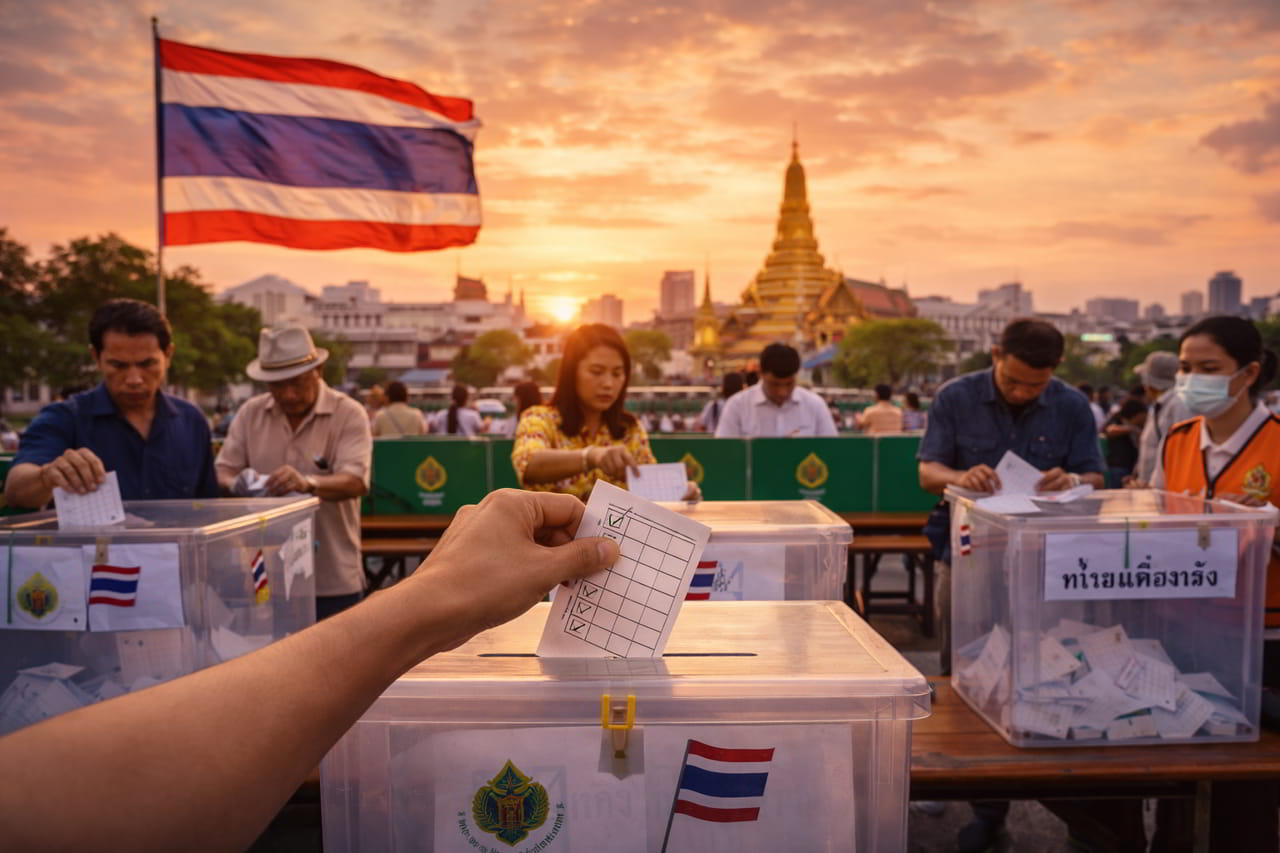
Thailand’s recent general election delivered a clear victory to a conservative political force led by Prime Minister Anutin Charnvirakul. Many analysts had expected stronger results from reformist parties, particularly popular among younger voters and urban residents.
What often surprises foreign readers is how Thai democracy actually works. Elected governments operate within a system heavily influenced by long-standing institutions — the military, the constitutional court and the monarchy. Parties seen as pushing reform too far have repeatedly been dissolved or blocked from power.
For a large share of voters, especially outside Bangkok, stability, national security and economic continuity mattered more than political reform. Regional tensions and a fragile post-pandemic economy reinforced that choice.
Election results: political balance in parliament
| Political group | Profile | Estimated seats |
|---|---|---|
| Governing conservative party (Bhumjaithai) | Conservative, pro-stability | ~194 |
| People’s Party (formerly Move Forward) | Reform-oriented, progressive | ~116 |
| Pheu Thai | Populist, former ruling party | ~76 |
| Other parties | Mixed | ~114 |
Thailand’s lower house has 500 seats. Coalition government remains the norm.
Seat numbers are estimates based on official results and coalition negotiations.
What changes for expats in Thailand after the elections
Tourism: more oversight, not fewer visitors
For travelers, the new government is not signalling a clampdown on tourism. Thailand remains one of the world’s most tourism-dependent economies.
What is changing is the level of oversight. Authorities want clearer rules, better revenue collection and fewer grey areas. The long-discussed arrival fee has re-entered public debate, framed as a small contribution to healthcare and infrastructure rather than a barrier to entry.
In practical terms, tourists are still welcome — but long stays, repeated visa runs and loosely justified extensions are more closely monitored than before.
Cannabis: from bold experiment to tighter control
Thailand surprised the world by becoming the first Southeast Asian country to legalise cannabis. The move, championed by the current prime minister, rapidly reshaped city streets and tourist habits.
That phase is now being reined in. The conservative government wants clearer boundaries, particularly around recreational use. For expats and travelers, this means stricter enforcement, local differences in interpretation and far less tolerance for ambiguity.
Cannabis remains legal, but the “anything goes” perception is fading fast.
Expat taxes: the end of the informal arrangement
Taxation is where many expats feel the shift most clearly. Thailand is now applying existing tax rules more consistently, particularly regarding foreign income brought into the country.
This is not an anti-expat policy as such. It reflects a broader conservative approach: strengthening state revenue without increasing taxes on Thai citizens.
For long-term foreign residents, the era of informal assumptions is ending. Financial transparency and proper tax planning are increasingly necessary.
Visas: same categories, stricter enforcement
Visa options have not disappeared. Retirement, work, education and long-stay visas remain available.
What has changed is enforcement. Immigration authorities now expect visas to align closely with real, documented situations. Practices once quietly tolerated — serial tourist visas or loosely justified stays — attract more scrutiny.
For expats already compliant, this brings predictability. For others, it marks the end of flexibility by default.
Environmental policy: practical and tourism-driven
Environmental measures under the conservative government are pragmatic rather than ideological. The focus is on air pollution, water management and protecting heavily visited natural areas.
Travelers see this through seasonal island closures, limits in national parks and tighter regulation of tourist activities. These decisions are usually framed in economic and sustainability terms, not environmental activism.
What will not change in Thailand after the elections
Despite online speculation, the new government does not represent a sudden break with Thailand’s past.
- Thailand remains open to international visitors
- Major visa pathways remain unchanged
- Bureaucracy stays complex, but rarely shifts overnight
- Law-abiding expats face no sudden lifestyle disruption
- Thailand remains safe, stable and welcoming by regional standards
Policy adjustments are gradual, not dramatic.
FAQ – What expats and travelers should know
Do Thailand’s elections affect tourism?
No immediate disruption is expected. Tourism remains a priority, with gradual regulatory adjustments rather than sudden restrictions.
Is Thailand becoming less friendly to foreigners?
No. Rules are applied more consistently, not more harshly.
Should tourists worry about new restrictions?
No immediate changes. Tourism remains a national priority.
Is cannabis still legal?
Yes, but recreational use is increasingly regulated.
Are expats paying more tax?
Enforcement of existing tax laws is stricter.
Are visas harder to get?
Visa options remain, but misuse is more closely monitored.
Thailand’s new conservative government does not rewrite the rules overnight. It replaces informal flexibility with clearer boundaries — a shift that expats and travelers can navigate easily with the right information.