



Thailand-Cambodia: What Does the UNCLOS Maritime Conciliation Mean?
Written by the editors of theo-courant.com, your reference guide to Thailand and South-East Asia - based in Bangkok, at the heart of Thai culture.

Thailand and Cambodia have begun a conciliation process in Singapore under the United Nations Convention on the Law of the Sea (UNCLOS). At the heart of the dispute is a large area of overlapping maritime claims in the Gulf of Thailand, close to Koh Kood. But where exactly is the disputed area, and what can this international procedure actually achieve?
Thailand and Cambodia begin maritime conciliation in Singapore
The maritime dispute between Thailand and Cambodia has entered a new phase this week. From September 14 to 16, 2026, representatives of both countries are meeting in Singapore as part of a conciliation commission established under UNCLOS.
Opening statements from the two delegations are being made on September 15. Cambodia’s delegation is led by Foreign Minister Prak Sokhonn, while Thailand is represented by Foreign Minister Sihasak Phuangketkeow.
Cambodia initiated the procedure in June, after Thailand ended on May 5, 2026, the bilateral framework established by the 2001 Memorandum of Understanding on overlapping maritime claims.
The current process is neither a court case nor an arbitration proceeding. A five-member conciliation commission will examine the positions of both countries and make recommendations aimed at helping them resolve the dispute.
Those recommendations will not be legally binding.
Where is the maritime boundary dispute?
To understand the issue, it is necessary to look beyond the familiar land border between Thailand and Cambodia and towards the Gulf of Thailand.
The disputed area lies in the northeastern part of the Gulf, between Thailand’s eastern coastline and the Cambodian coast. It includes waters off Thailand’s Trat province, facing Cambodia’s Koh Kong and Sihanoukville provinces.
This is also where Koh Kood is located.
Known as Ko Kut in Thailand, the island is part of Trat province and is a popular beach destination in eastern Thailand. Its location close to the Cambodian border has made it one of the most recognizable geographical points in discussions about the maritime dispute.
Why does Koh Kood matter?
For travelers, Koh Kood is mainly known for its beaches, clear waters and relatively quiet atmosphere.
For Thailand and Cambodia, its geographical position makes the island much more significant.
The two countries have overlapping maritime claims in waters around this part of the Gulf of Thailand. This is why Koh Kood is frequently mentioned when the dispute is discussed in the media and political debate.
However, two separate issues need to be distinguished.
The first concerns sovereignty over the island itself. Thailand’s official position is that Koh Kood is Thai territory and that its sovereignty is not subject to negotiation through the current UNCLOS process.
The second concerns the maritime delimitation around the island and across the wider area of the Gulf.
This second issue is at the center of the current conciliation.
In other words, the process does not mean that Koh Kood itself is being divided between Thailand and Cambodia. The question is how the maritime areas claimed by the two countries should be delimited.
The disputed area extends far beyond Koh Kood
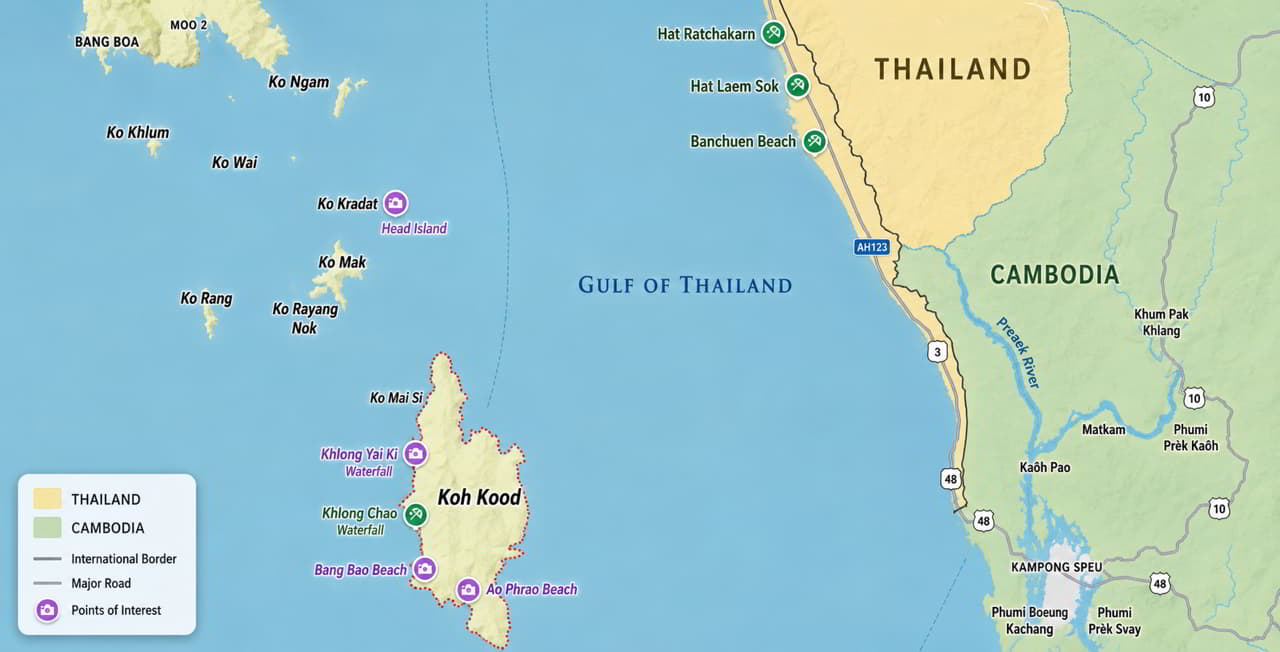
Koh Kood provides a familiar reference point, but the island represents only a small part of a much larger maritime issue.
The dispute concerns a broader area of overlapping claims in the Gulf of Thailand, commonly referred to as the Overlapping Claims Area, or OCA.
The 2001 Memorandum of Understanding created a framework for Thailand and Cambodia to discuss their competing maritime claims and the resources that could potentially be developed in the area.
The issue is therefore geographical, legal and economic at the same time.
The seabed of the Gulf of Thailand is considered significant for energy resources, which adds a strategic dimension to the negotiations.
However, the current conciliation does not amount to an immediate allocation of oil or gas fields to either country.
The first issue is the maritime boundary itself.
Why did the 2001 framework end?
For more than two decades, the 2001 Memorandum of Understanding provided the bilateral framework for discussions over the two countries’ overlapping maritime claims.
Those negotiations did not produce a final agreement on the maritime boundary.
On May 5, 2026, Thailand announced that it was ending the framework.
Bangkok argued that the bilateral mechanism had not produced sufficient progress. Cambodia subsequently turned to the compulsory conciliation procedure provided for under UNCLOS.
Thailand has agreed to participate while maintaining its position that the process concerns maritime delimitation rather than sovereignty over Koh Kood.
The two countries are therefore now addressing the dispute through a different legal and diplomatic framework.
What does UNCLOS conciliation actually mean?
UNCLOS, the United Nations Convention on the Law of the Sea, provides an international legal framework for dealing with disputes involving the interpretation and application of maritime law.
Conciliation is different from a court proceeding.
The five members of the commission are not being asked to issue a judgment awarding maritime territory to Thailand or Cambodia.
Instead, they will examine the positions of both sides, facilitate discussions and eventually issue recommendations intended to help the countries reach a settlement.
This distinction is important because the recommendations are not legally binding.
At the same time, the procedure is more than a simple bilateral negotiation between two governments. It places the dispute within a formal international framework and could provide a way forward after years of limited progress through bilateral talks.
Has another country used the same procedure?
There is a particularly relevant international precedent, although it should not be treated as a guarantee of the outcome in the Gulf of Thailand.
The most directly comparable case involved Timor-Leste and Australia.
In 2016, Timor-Leste initiated compulsory conciliation against Australia under UNCLOS over their maritime boundaries in the Timor Sea.
The process helped bring the two countries back to negotiations and eventually led to the signing of the 2018 Maritime Boundary Treaty.
The treaty established a permanent maritime boundary between Timor-Leste and Australia and entered into force in 2019.
A positive precedent, but no guarantee
The Timor-Leste-Australia case is therefore an example of a conciliation process that contributed to a successful settlement.
But the circumstances were different.
The historical, political and geographical context of the Gulf of Thailand is not the same as that of the Timor Sea. Thailand and Cambodia also have a particularly sensitive relationship with a history of disputes over both land and maritime boundaries.
The Timor-Leste precedent shows that compulsory conciliation can help overcome a diplomatic deadlock. It does not mean that Thailand and Cambodia will necessarily reach an agreement through the same process.
Ultimately, the states themselves must decide whether to accept and implement a compromise.
What happens next?
The Singapore meeting is the beginning of the process, not its conclusion.
The commission will continue examining the dispute, hear the positions of both countries and establish the framework for its work.
Its eventual recommendations are intended to help the two governments reach a settlement, but they will not constitute a binding judgment imposed on either side.
For now, three elements will be particularly important to follow:
- how the commission organizes its work;
- the detailed positions presented by Thailand and Cambodia on maritime delimitation;
- whether both countries are prepared to use the commission’s recommendations as a basis for renewed negotiations.
As of September 15, 2026, no new maritime boundary has been agreed between Thailand and Cambodia.
What does the dispute mean for travelers visiting Koh Kood?
For travelers, the most important point is straightforward: the current conciliation process does not change Koh Kood’s status as a Thai tourist destination.
The island remains administered by Thailand, and the proceedings in Singapore do not constitute an immediate change to its tourism status or access.
The dispute is currently being handled through diplomatic and legal channels.
For visitors, Koh Kood is therefore more useful as a geographical reference point than as a direct indicator of any change to travel conditions.
The island makes an otherwise abstract issue easier to understand. On a map, the dispute involves maritime boundaries and overlapping claims across the Gulf of Thailand. On the ground, it is a region that includes a well-known Thai island only a short distance from Cambodia.
A maritime dispute that goes beyond Koh Kood
Koh Kood is likely to remain closely associated with the issue because it provides a recognizable geographical and political reference point.
But the dispute is considerably broader.
At its core is the delimitation of maritime areas in the Gulf of Thailand and the rights associated with those waters and seabed areas.
The conciliation process now underway in Singapore represents an attempt to place the issue within an international framework after the end of the 2001 bilateral mechanism.
The experience of Timor-Leste and Australia shows that compulsory conciliation can contribute to a negotiated settlement. It also demonstrates that the procedure itself is not the final answer: an agreement ultimately depends on the willingness of the countries involved to reach and accept a compromise.
For Thailand and Cambodia, the key question is therefore whether this new process can achieve what the previous bilateral framework could not: bring the two sides closer to an agreement on a maritime boundary that remains unresolved.
FAQ
Is Koh Kood part of the Thailand-Cambodia maritime dispute?
Koh Kood is located in the geographical area close to the two countries’ overlapping maritime claims. Thailand maintains that its sovereignty over the island is not subject to negotiation in the current UNCLOS process.
Could Thailand lose Koh Kood?
The current conciliation does not concern the transfer of sovereignty over Koh Kood. It focuses on maritime delimitation between Thailand and Cambodia.
What will the UNCLOS commission decide?
The commission is not a court. It will examine the dispute and issue non-binding recommendations intended to help the two countries reach a settlement.
Has this procedure worked elsewhere?
Yes. Timor-Leste and Australia used compulsory UNCLOS conciliation from 2016, leading to negotiations and a maritime boundary treaty in 2018.
Will the process affect travel to Koh Kood?
The current diplomatic process does not change Koh Kood’s status as a Thai tourist destination.
Sources
Reuters, September 15, 2026; Royal Thai Government / Ministry of Foreign Affairs; United Nations Convention on the Law of the Sea; Permanent Court of Arbitration; Government of Timor-Leste; Australian Department of Foreign Affairs and Trade.