


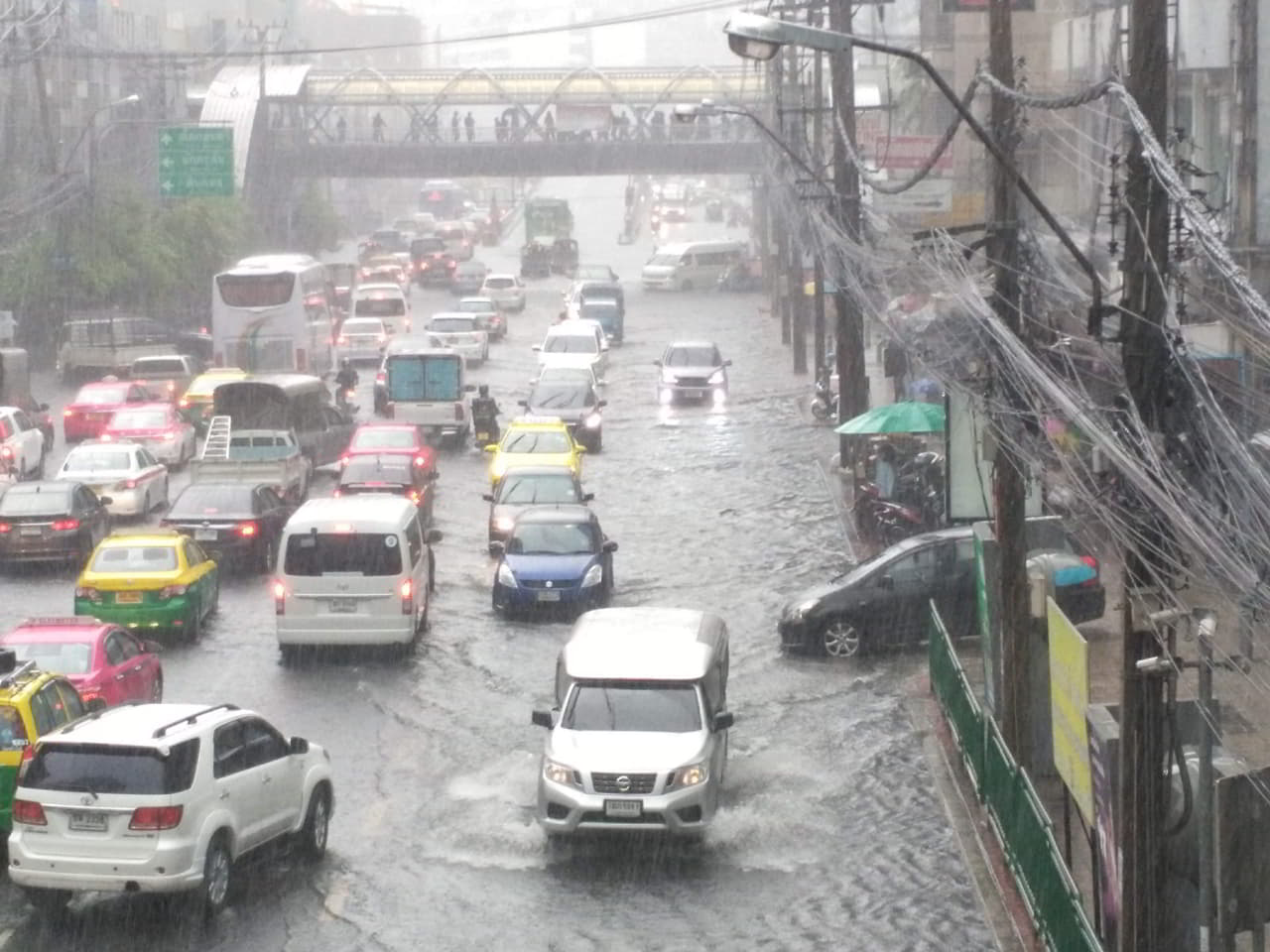
Bangkok Floods: Can You Still Get Around and Reach the Airports?
Written by the editors of theo-courant.com, your reference guide to Thailand and South-East Asia - based in Bangkok, at the heart of Thai culture.

After almost 300 mm of rain fell within 48 hours, Bangkok has experienced widespread flooding, disrupting traffic in several parts of the capital. All 50 Bangkok districts have been declared disaster areas. On Sunday, September 27, floodwaters were beginning to recede in some areas, but travelling around the city remained difficult.
For travellers, the key question is no longer simply whether Bangkok is accessible. It is how to get around the city and reach the airports under the current conditions.
Are Bangkok’s airports operating normally?
Yes. Suvarnabhumi Airport and Don Mueang International Airport remain open and operational.
According to the Tourism Authority of Thailand (TAT), the main difficulties currently concern road access to the two airports. Travellers are therefore advised to check traffic conditions before leaving and allow significantly more time for their journey. (TAT)
Suvarnabhumi Airport remains accessible
Suvarnabhumi Airport continues to handle international and domestic flights.
However, the TAT advises travellers to avoid the Lat Krabang area, where significant water accumulation has been reported.
When conditions allow, alternative routes including Motorway 7 and the Burapha Withi Expressway can be used to reach the airport.
Current guidance recommends allowing at least:
- three hours before an international flight;
- two hours before a domestic flight;
in addition to the time required to reach the airport, which can be considerably longer than usual because of traffic and flooding.
Suvarnabhumi: Flight Delays and Baggage Problems
Although Suvarnabhumi Airport remains open and operational, the flooding is now affecting some ground-handling operations.
Flight delays and significant baggage-handling problems were reported on September 27. Some passengers had to wait several hours to collect their luggage, with reported waiting times of up to five or six hours.
According to the Bangkok Post, some baggage-handling staff were unable to reach the airport because of the flooding. Problems involving some of the equipment used to move luggage also contributed to the disruption.
The situation can therefore be summed up simply: flights are continuing, but ground operations are not running normally in every area.
Travellers flying from Suvarnabhumi should therefore allow more time than usual, both for reaching the airport and for check-in, security procedures and any potential delays in baggage handling.
Don Mueang Airport is also operating
Don Mueang International Airport is also operating normally.
On September 26, part of the airport’s southern taxiway was affected by accumulated water. Airport teams pumped the water out, while take-offs and landings continued without reported changes to the flight schedule.
The main concern for passengers remains road access to the airport.
The TAT recommends allowing an additional two to three hours for the journey and checking traffic conditions before leaving.
Can you still travel around Bangkok?
The answer depends very much on where you are in the city.
Heavy rainfall on September 24 and 25 caused flooding and water accumulation along numerous roads. Authorities reported that 44 traffic locations had been affected, while 33 major roads were being closely monitored. Some roads were subject to warnings and restrictions rather than complete closures.
Parts of eastern Bangkok have been particularly affected, including areas around Min Buri, Khlong Sam Wa and Saphan Sung.
Several major roads have also experienced flooding or traffic disruption, including parts of:
- Chaeng Watthana Road;
- Vibhavadi Rangsit Road;
- Sena Nikhom Road;
- Ramkhamhaeng Road;
- Sukhumvit Soi 63, also known as Ekkamai;
- Lat Krabang Road.
Conditions can change quickly. A road that is difficult to use in the morning may become passable again after water has been pumped away.
Are the BTS and MRT still running?
Rail-based public transport is an important alternative when roads are congested or flooded.
The TAT reports that the Airport Rail Link and SRT Red Line are operating. Bangkok’s BTS Skytrain and MRT networks also provide alternatives for many journeys within the capital.
However, there is an important distinction between a railway line operating normally and being able to reach the station easily.
A BTS or MRT station may remain open while surrounding streets are flooded or heavily congested.
For airport journeys in particular, travellers should therefore consider the entire journey from their accommodation to the terminal, rather than simply checking whether the train itself is operating.
What is happening in Bangkok today?
Conditions have improved in some parts of the capital.
After the intense rainfall of September 24 and 25, floodwaters began to recede in several areas on Sunday, September 27. The reduction in rainfall has allowed authorities to accelerate drainage operations and lower water levels in affected areas.
This does not mean that travel conditions have returned to normal.
Authorities are continuing to monitor further rainfall expected across Bangkok and neighbouring provinces. Low-lying areas and locations close to canals remain particularly vulnerable.
Conditions may therefore change significantly during the day.
Travelling from Pattaya to Bangkok: What We Found on September 27
We travelled from Pattaya to Bangkok on Sunday, September 27, to see first-hand how road conditions had evolved after the heavy rainfall and flooding of the previous days.
On the main motorway between Pattaya and Bangkok, there were no major traffic problems during our journey. Traffic was generally flowing well along the main route.
The main difficulty was the condition of the road surface. Several sections were noticeably damaged, with numerous potholes that appeared or worsened following the flooding. Drivers should therefore remain cautious even when traffic itself is moving normally.
Conditions were very different on secondary roads. Several of these roads were still heavily covered by standing water, with substantial flooding in some areas.
Once we reached Bangkok, conditions varied considerably from one part of the city to another. While some major roads remained usable, several areas were still heavily flooded on September 27.
This experience shows why it is difficult to describe the situation in Bangkok as a whole. Road and flood conditions can vary significantly between neighbourhoods and even between nearby routes.
Two special public holidays in four areas
As heavy rain and flooding continued to affect travel, the Thai government announced special public holidays on Monday, September 28, and Tuesday, September 29, 2026, for government offices in four areas:
- Bangkok;
- Nonthaburi;
- Pathum Thani;
- Samut Prakan.
The measure is intended in particular to reduce travel in areas affected by flooding. Government services that can be provided online will continue to be available.
This does not mean that every business or service will close. The government has stated that private companies, banks, hospitals and state-owned enterprises should determine their own arrangements according to their circumstances. The Stock Exchange of Thailand, for example, will continue normal operations.
For travellers, the exceptional holidays may therefore affect some government offices and public services, but they do not amount to a general shutdown of Bangkok.
More than 400 schools operated by the Bangkok Metropolitan Administration are also closed on Monday, September 28, because of the flooding.
Information checked on September 27, 2026. Road conditions and administrative measures may change rapidly.
Should you change your Bangkok travel plans?
The available information does not indicate that Bangkok is inaccessible to travellers.
Both major airports remain operational and the main rail networks are running. However, journeys by road can take considerably longer than usual, particularly when travelling to the airports.
If you need to travel around Bangkok today, it is therefore advisable to:
- check traffic conditions before leaving;
- allow plenty of extra time when travelling to an airport;
- check your flight status directly with your airline;
- use rail-based transport when it is practical for your route;
- avoid areas currently reported to be flooded;
- check conditions again shortly before setting out.
Flooding is not affecting every part of Bangkok in the same way. The capital is not entirely paralysed, but some journeys can currently take much longer than expected.
Bangkok floods: what travellers need to know
| Situation | Status on September 27, 2026 |
|---|---|
| Suvarnabhumi Airport | Open and operational |
| Don Mueang Airport | Open and operational |
| Airport Rail Link | Operating |
| SRT Red Line | Operating |
| BTS / MRT | Operating, with local access conditions varying |
| Road traffic | Disrupted in several areas |
| Lat Krabang | Area to avoid for road access to Suvarnabhumi |
| Bangkok | Conditions improving in some areas but still changeable |
Last checked: September 27, 2026. Road, transport and flood conditions can change rapidly depending on rainfall and water levels.
Sources
- Tourism Authority of Thailand (TAT), Weather and Travel Conditions in Bangkok and Surrounding Areas – Visitor Information, September 26, 2026.
- The Nation Thailand, Don Mueang flights unaffected by taxiway flooding on Sept 26, September 26, 2026.
- Bangkok Metropolitan Administration and information reported by Thai media.