


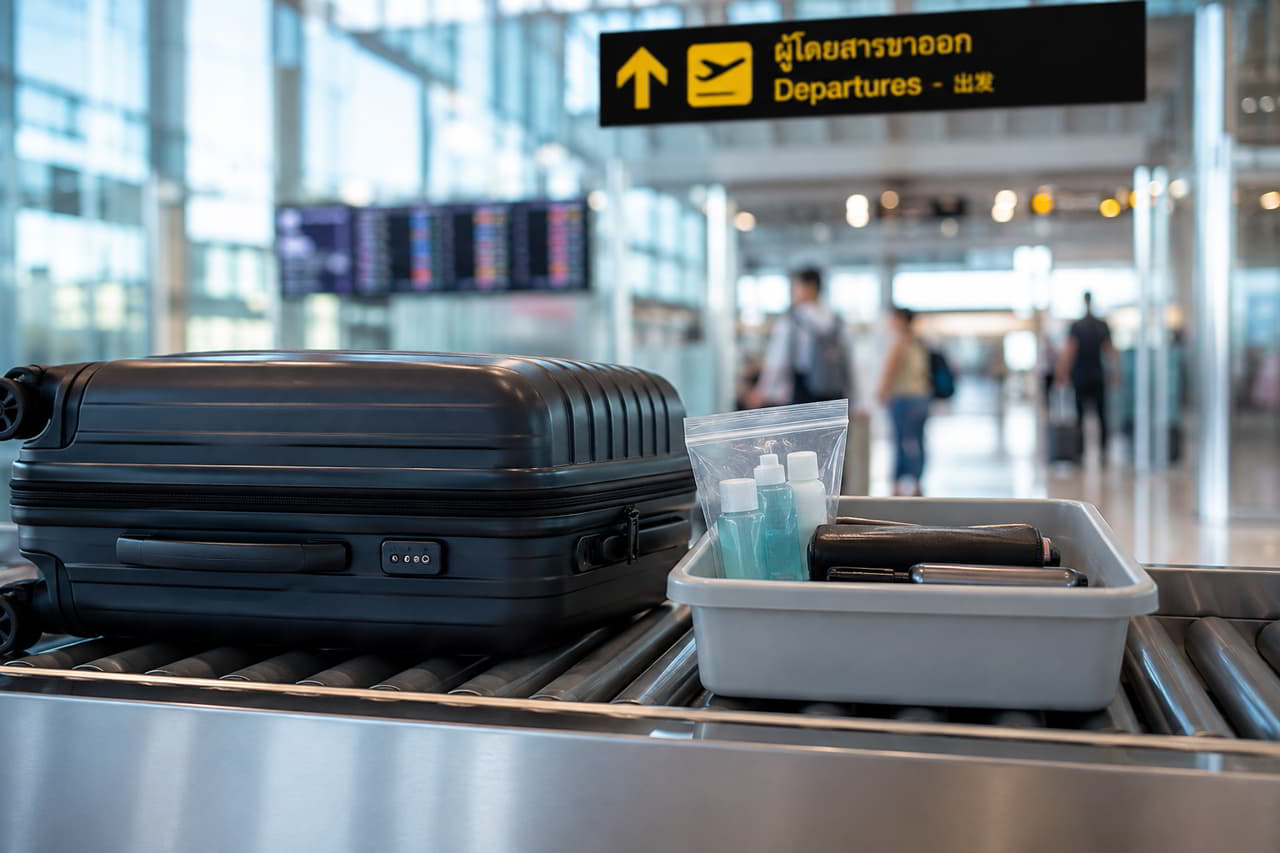
Luggage in Thailand: Rules, Prohibited Items and Airport Checks
A power bank in the wrong bag can quickly complicate your journey. When travelling to Thailand, it is important to check the latest rules on luggage, batteries and airport security before you fly.
Preparing your luggage for a trip to Thailand involves more than simply staying within your airline’s weight allowance. Rules vary depending on the type of baggage and the items you are carrying, while airport security procedures in Thailand are also changing in 2026.
Update – August 2026: new regulations are scheduled to come into effect on 16 October 2026. Under certain circumstances, they will allow security officers to open and inspect checked baggage without the passenger being present.
Here are the main luggage rules to know before flying to or from Thailand.
Key point: power banks and spare lithium batteries must be carried in your cabin baggage rather than in checked luggage. Thai airport authorities also recommend using a TSA-approved lock on checked bags.
New luggage regulations in Thailand: what changes in October 2026
From 16 October 2026, new rules governing the inspection of checked baggage are scheduled to come into effect at Thai airports.
The changes are intended to strengthen security controls and standardise procedures for inspecting checked luggage.
Under certain circumstances, security officers will be able to open and inspect a checked bag without its owner being present.
Why can a suitcase be opened?
A bag may be selected for inspection if a security screening identifies something suspicious or indicates that it could contain a prohibited item.
The purpose is to allow security officers to check the contents of the bag before it is loaded onto the aircraft.
Having your suitcase opened does not necessarily mean that you have committed an offence. A bag may simply be selected as part of routine security screening procedures.
How does the inspection work?
Under the new procedures, the opening and inspection of a bag must be carried out according to the procedures established by the airport authorities.
The operation may also be recorded in order to keep a trace of the inspection.
After the inspection, a notification may be placed inside the luggage to inform the owner that the bag has been opened.
Can you prevent your suitcase from being opened?
No.
A padlock or other locking mechanism does not allow a passenger to prevent a security inspection.
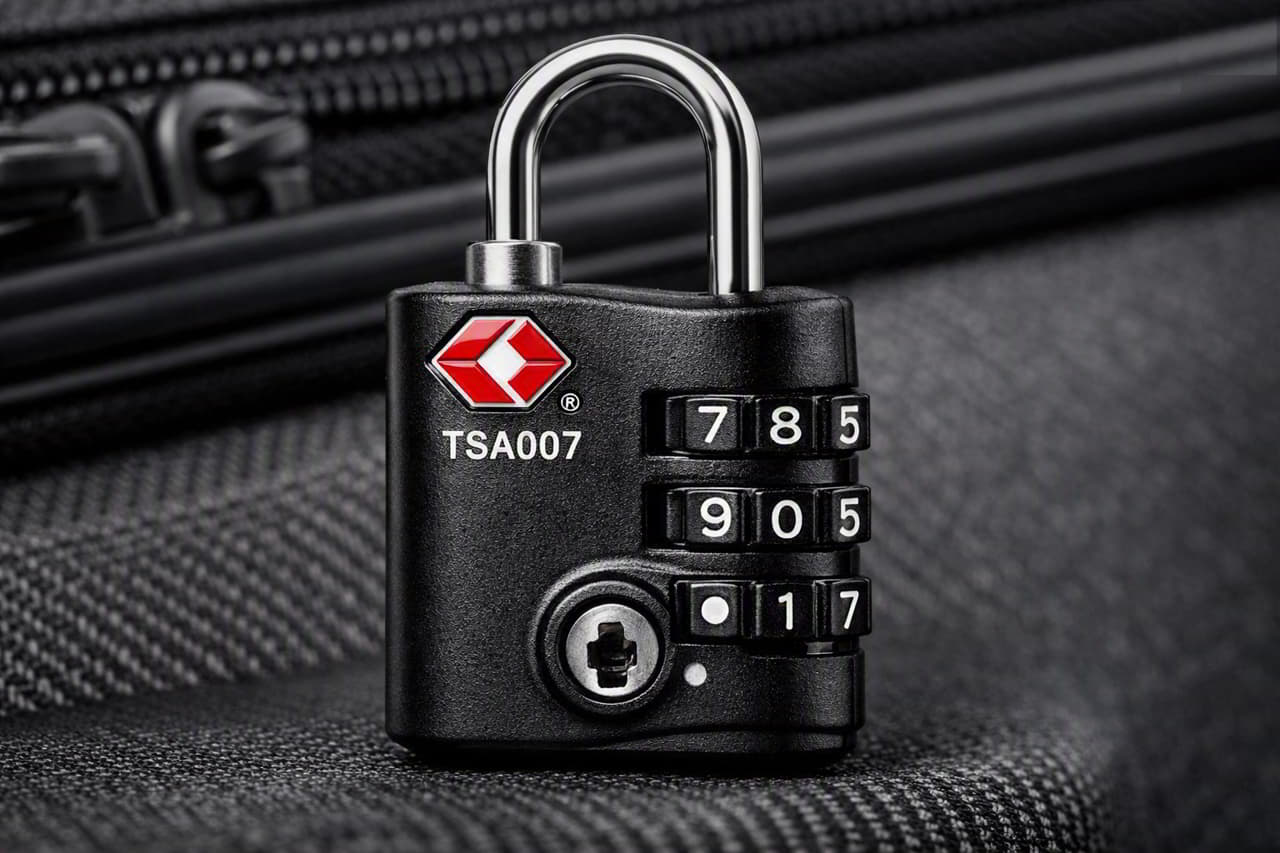
This is one reason why airport authorities recommend that travellers using locks on checked luggage choose a TSA-approved model.
A compatible lock can be opened by authorised personnel using the appropriate system without necessarily damaging the suitcase.
Cabin baggage or checked luggage: what is the difference?
Before packing your suitcase, it is important to understand the difference between the two main types of baggage.
Cabin baggage
Cabin baggage stays with you during the flight, subject to your airline’s rules and airport security requirements.
It is particularly suitable for carrying:
- passport and travel documents;
- cash and bank cards;
- laptop;
- phone and other electronic devices;
- power banks;
- spare lithium batteries;
- medication needed during the journey;
- fragile or valuable items.
However, permitted dimensions and weight depend on the airline and the fare you have purchased.
Always check your airline’s baggage allowance before departure.
Checked baggage
Checked baggage is handed over at the check-in counter or baggage drop-off point before you proceed through security.
It is transported in the aircraft’s hold.
It is generally used for:
- clothing;
- shoes;
- permitted toiletries;
- bulky items;
- equipment that you do not need during the flight.
Some items are nevertheless prohibited in checked luggage, including certain types of batteries and devices containing lithium batteries.
Which items are prohibited in luggage in Thailand?
The rules are not the same for every item. It is useful to distinguish between three categories:
- items prohibited in the cabin but permitted in checked baggage;
- items prohibited in checked baggage but permitted in the cabin;
- items prohibited in both types of baggage.
Power banks and spare batteries
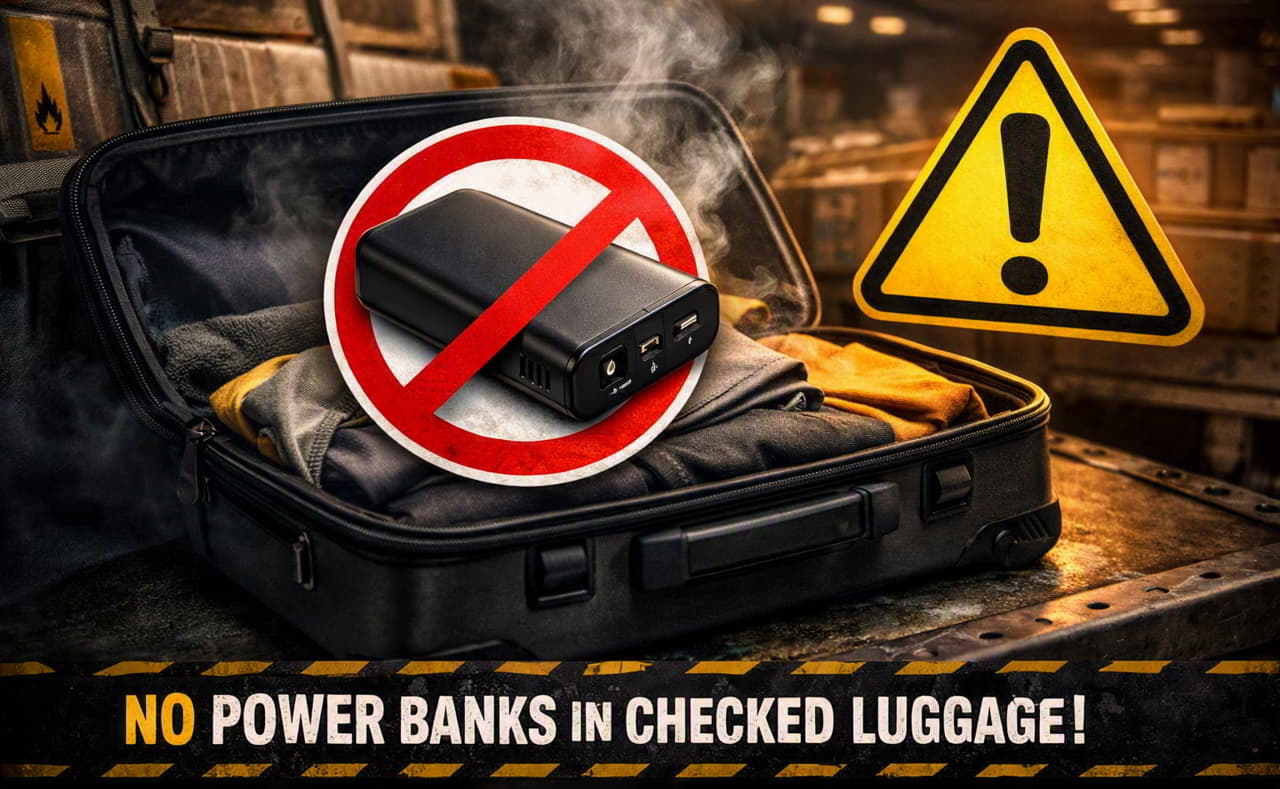
Power banks must be carried in cabin baggage and not in checked luggage.
The same rule applies to spare lithium batteries.
Make sure you remove your power bank from your suitcase before checking your luggage.
Tip: if you are travelling with several electronic devices, also check the capacity limits and specific requirements imposed by your airline.
Laptops and electronic devices
Laptops, tablets, cameras and other electronic equipment are generally better carried in your cabin baggage.
This helps to:
- protect them from damage;
- keep them under your supervision;
- make them easier to present during security screening;
- avoid certain issues related to batteries.
Liquids
Rules governing liquids depend, among other things, on the type of baggage and the airport’s security screening procedures.
For cabin baggage, liquids must comply with the restrictions applicable at the security checkpoint.
Toiletries should therefore be packed in suitable containers and prepared before you reach the airport.
Rules may be different for checked baggage, although certain substances remain prohibited.
Important: regulations can change, and individual airlines or airports may apply specific procedures. Always check the latest information before travelling.
E-cigarettes and vaping: an important warning for travellers to Thailand
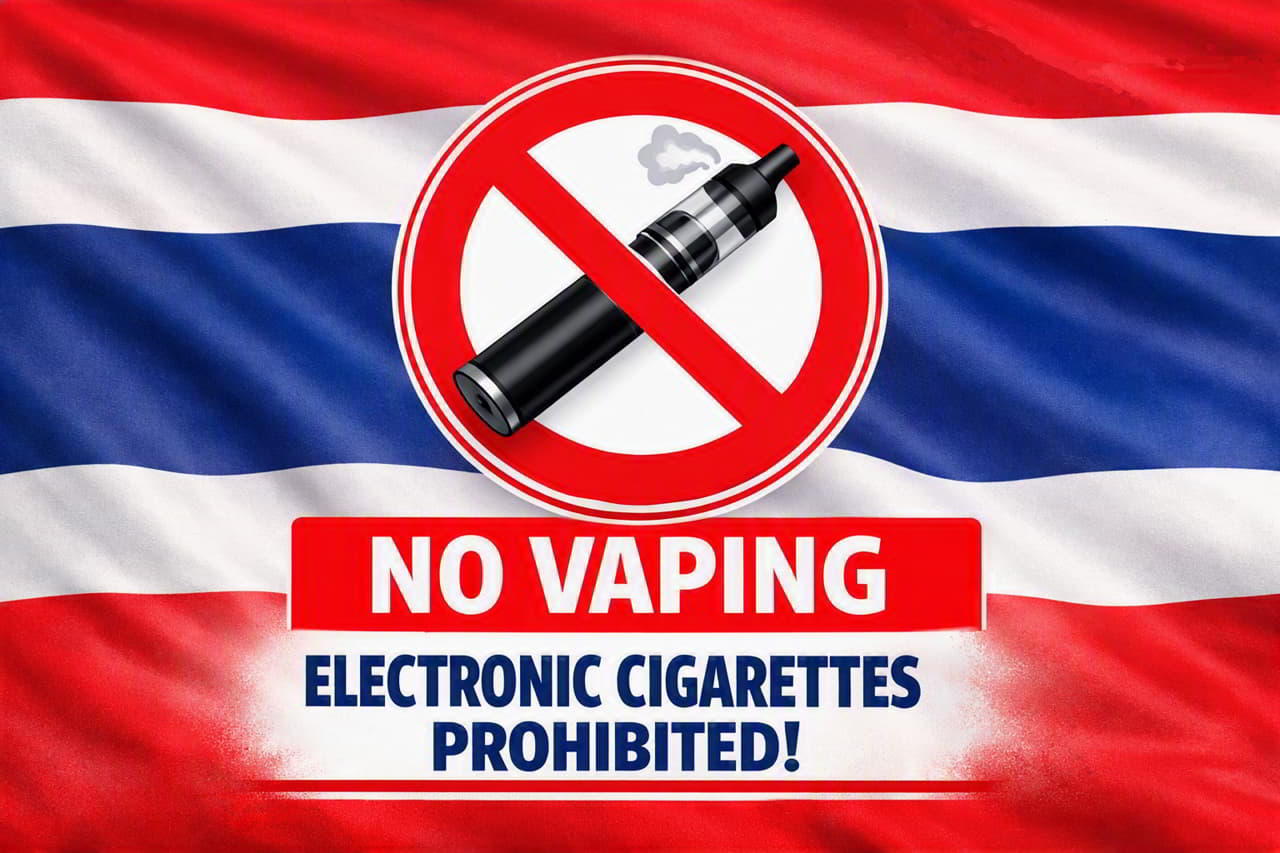
E-cigarettes are prohibited in Thailand. The ban covers, in particular, the import, possession and use of e-cigarettes and related products.
Travellers should therefore not bring vapes, e-cigarettes, pods or similar devices in their luggage when travelling to Thailand.
This legislation is separate from airline safety rules concerning lithium batteries. Even if an e-cigarette is subject to specific rules for carriage on an aircraft, this does not mean that it is legal to bring it into Thailand.
Advice: if you are travelling to Thailand, do not pack an e-cigarette or vape in either your cabin or checked baggage, and do not plan to purchase or use one while in the country.
Which items should go in your cabin or checked baggage?
| Item | Cabin | Checked | Advice |
|---|---|---|---|
| Power bank | ✅ | ❌ | Keep in cabin |
| Spare lithium battery | ✅* | ❌ | Check capacity limits |
| Smartphone | ✅ | ⚠️ | Prefer cabin |
| Laptop | ✅ | ⚠️ | Prefer cabin |
| Camera | ✅ | ⚠️ | Protect against damage |
| Passport | ✅ | ❌ | Always keep with you |
| Cash and bank cards | ✅ | ❌ | Never place in checked luggage |
| Essential medication | ✅ | ⚠️ | Keep supporting documents with you |
| E-cigarette / vape | ❌ | ❌ | Prohibited in Thailand |
| Liquids | ⚠️ | ✅* | Follow applicable rules |
| Valuables | ✅ | ❌ | Do not place in checked luggage |
| Dangerous items | ❌ | ❌/⚠️ | Check the applicable regulations |
* Subject to safety requirements and your airline’s rules.
Why use a TSA-approved lock on your suitcase?
Thai airport authorities recommend using locks compatible with TSA procedures for checked luggage.
The reason is straightforward: your suitcase may be selected for a security inspection while you are already elsewhere in the terminal or even on board the aircraft.
A conventional padlock may have to be forced or damaged if security officers need to access the contents of the bag.
With a TSA-approved lock, authorised personnel have an appropriate way to open and secure the luggage during an inspection.
Is a TSA-approved lock mandatory in Thailand?
No.
It is a recommendation rather than a general requirement for all travellers.
However, if you are travelling with checked luggage, it is a practical precaution that can reduce the risk of damage to the locking mechanism if your bag needs to be inspected.
What happens if security opens your suitcase?
A checked bag may be inspected without the passenger being present.
In such a case, several steps may be involved:
- the bag is identified during screening;
- security officers inspect it;
- its contents are checked according to the applicable procedure;
- a prohibited item may be removed or dealt with according to the relevant procedure;
- the bag is closed again;
- a notification may be placed inside.
If you discover that your suitcase has been opened when you arrive, check its contents and look for a possible inspection notice.
If an item is missing or your luggage has been damaged, contact your airline’s baggage service or the relevant airport service as soon as possible.
How to prepare your luggage before flying to Thailand
A few simple precautions can reduce problems at check-in and during security screening.
1. Check your airline’s baggage rules
Baggage weight and dimensions can vary considerably from one airline to another.
A suitcase accepted by one carrier may therefore be considered overweight or oversized by another.
2. Keep batteries in your cabin baggage
Do not place your power banks or spare lithium batteries in checked luggage.
Keep them accessible in your cabin bag.
3. Keep valuables with you
Your passport, cash, jewellery, laptop, camera and other valuable items should remain in your cabin baggage.
4. Do not put important documents in checked luggage
Keep the following with you:
- passport;
- tickets and reservations;
- insurance documents;
- payment methods;
- essential administrative documents.
5. Label your suitcase
Add a luggage tag with your contact details and, ideally, a phone number where you can be reached during your trip.
You can also add a distinctive mark to your suitcase to make it easier to identify on the baggage carousel.
6. Take photos of your luggage
Taking a few photographs of your suitcase before departure can be useful if your baggage is lost, damaged or difficult to identify.
7. Use an appropriate lock
If you choose to lock your checked suitcase, use a TSA-approved model.
8. Do not carry an item if you are unsure about its status
If you are unsure whether an item is allowed, check the applicable rules before placing it in your luggage.
This is particularly important for:
- batteries;
- electronic devices;
- chemicals;
- sharp objects;
- sports equipment;
- aerosols;
- food or plant products.
What should you check before closing your suitcase?
A final check can save you from having to reopen your luggage at the last minute.
Cabin baggage checklist
- [ ] Passport
- [ ] Cash and bank cards
- [ ] Phone
- [ ] Laptop or tablet
- [ ] Power bank
- [ ] Spare batteries
- [ ] Essential medication
- [ ] Travel documents
- [ ] Fragile or valuable items
Checked baggage checklist
- [ ] Clothing
- [ ] Shoes
- [ ] Permitted toiletries
- [ ] Non-fragile items
- [ ] No power bank
- [ ] No spare lithium batteries
- [ ] No prohibited items
- [ ] Suitcase properly labelled
- [ ] TSA-approved lock if required
Common luggage mistakes to avoid in Thailand
Some of the most common mistakes are also the easiest to avoid.
Putting your power bank in checked luggage
This is one of the most common mistakes.
A power bank must remain in your cabin baggage.
Putting your passport in your checked suitcase
Never place your passport in luggage that will be sent into the aircraft hold.
Carrying prohibited items without checking
An everyday household item may be subject to restrictions when travelling by air.
If in doubt, check the rules published by the airport and your airline.
Locking your suitcase with an unsuitable padlock
A conventional lock does not guarantee that your luggage cannot be opened during a security inspection.
A TSA-approved locking system is preferable for checked baggage.
Relying on an old list found online
Rules concerning luggage, batteries and security screening can change.
Always check the latest official information before travelling.
Can luggage rules in Thailand change?
Yes.
Aviation regulations and security procedures are regularly updated.
Rules can also vary depending on:
- the departure airport;
- the arrival airport;
- the airline;
- the type of luggage;
- the item being transported;
- applicable international regulations.
For this reason, the information in this article should be considered a practical guide, not a substitute for official instructions.
Before every trip, check the latest rules published by your airline and the airport concerned.
FAQ – Luggage and airport security in Thailand
Can Thai authorities open my suitcase without me?
Yes. From 16 October 2026, the new procedures will allow, under certain circumstances, a checked bag to be inspected while its owner is not present.
Can I put a power bank in my checked suitcase?
No. Power banks must be carried in cabin baggage rather than in checked luggage.
Is a TSA-approved lock mandatory when travelling to Thailand?
No, but airport authorities recommend using a TSA-compatible lock on checked luggage.
What happens if my suitcase is opened while I am away?
The bag may be inspected according to security procedures. A notification may be placed inside to inform the passenger that an inspection has taken place.
Can I put my laptop in checked luggage?
It is generally better to carry a laptop in your cabin baggage, particularly to protect it from damage and keep the device with you.
Where should I put spare batteries?
Spare lithium batteries should be carried in cabin baggage, subject to the applicable safety limits and your airline’s requirements.
Can I bring medication on a flight to Thailand?
In many cases, yes. However, certain medicines may be subject to specific restrictions in Thailand. Travellers carrying medication should check the applicable regulations before departure.
Are luggage rules the same at every airport in Thailand?
The main aviation security rules are broadly shared, but specific procedures can vary depending on the airport, airline and circumstances. It is therefore advisable to check the latest information before travelling.
Key points to remember
Travelling to Thailand with luggage is generally straightforward if you prepare your bags correctly.
Three basic rules are particularly important:
Keep power banks and spare lithium batteries in your cabin baggage.
Never place your passport, essential medication or valuables in checked luggage.
If you use a lock on your checked suitcase, choose a TSA-approved model.
From 16 October 2026, travellers will also need to take into account new checked-baggage inspection procedures, which may allow security officers to open a suitcase without its owner being present in certain circumstances.
As regulations can change, always check the latest instructions from your airline and the airport before travelling.
Official sources and useful information
- Airports of Thailand (AOT) – recommendations concerning checked-baggage inspections
- Suvarnabhumi Airport – luggage and battery regulations
- Thai Airways – cabin and checked-baggage rules
- Airports of Thailand – passenger information
- Civil Aviation Authority of Thailand (CAAT) – aviation security regulations
More practical information

🔄 Last updated: August 2026
Luggage and aviation security regulations can change. This page is regularly updated to reflect major changes affecting travellers arriving in or departing from Thailand.