

Phuket, Samui, Koh Phangan: Thailand Tightens Scrutiny on Foreign-Owned Businesses
Written by the editors of theo-courant.com, your reference guide to Thailand and South-East Asia - based in Bangkok, at the heart of Thai culture.

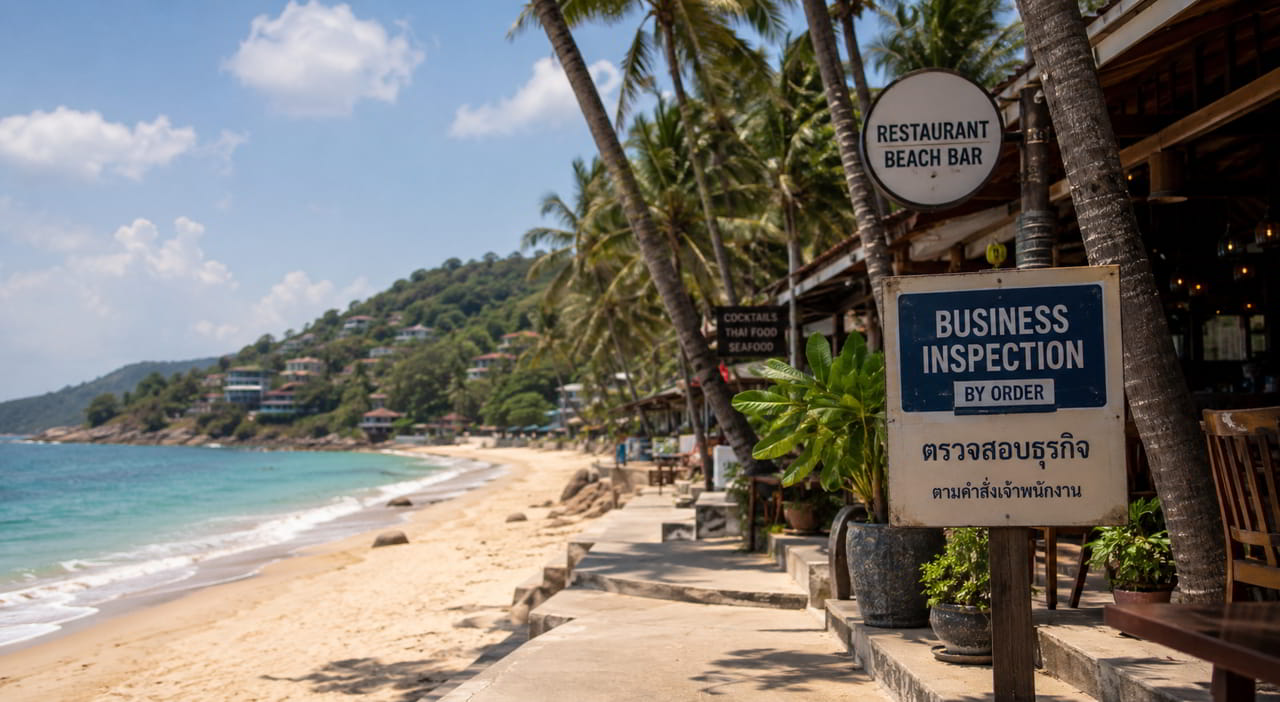
Restaurants, villas, cafés, real estate agencies and yoga schools: across Thailand’s southern tourist islands, authorities are stepping up investigations into businesses allegedly controlled by foreigners through Thai nominee structures. Behind this crackdown, Bangkok is trying to regain control over a tourism economy that has become increasingly international.
A tourism economy increasingly shaped by foreign investment
For decades, Koh Samui and Koh Phangan relied mainly on fishing, coconut plantations and a relatively modest tourism industry. But since the 1980s, Thailand’s gradual opening to international tourism has profoundly transformed these islands in the Gulf of Thailand. Phuket followed a similar path, though on a much larger scale.
As international arrivals surged, investment boomed. Hotels, cafés, restaurants, diving centers, sports clubs, real estate agencies and luxury villas multiplied rapidly. On Koh Samui, tourism now attracts millions of visitors each year and has become the island’s main economic engine.
This tourism boom also led to the growing internationalization of local businesses. According to Thailand’s Department of Business Development (DBD), 11,426 companies linked to foreign investment were identified on Koh Samui and Koh Phangan, representing nearly 68% of all registered businesses on the two islands.
The nationalities most commonly associated with these businesses vary depending on the area, but authorities frequently mention:
- French;
- British;
- Russian;
- Israeli;
- Chinese investors.
On Koh Phangan, Israeli, French, British and Russian investors are among the most visible groups. On Koh Samui, French, British, Russian, Chinese and Israeli entrepreneurs dominate parts of the tourism and property sectors.
Tourism growth has transformed the islands’ economy
The current pressure on foreign-owned businesses is also tied to the spectacular growth of tourism in southern Thailand over the past decade.
In Phuket, the post-pandemic recovery has been particularly strong. According to the Tourism Authority of Thailand (TAT), the island welcomed 3.89 million visitors between January and March 2025, generating nearly 149 billion baht in tourism revenue. International arrivals now fluctuate between 17,000 and 18,000 visitors per day.
The real estate and hospitality sectors are expanding at the same pace. Phuket International Airport recorded more than 2.7 million international passengers during the first half of 2025, up 5.6% year-on-year. Since 2015, international arrivals to Phuket have increased by an average of 4.6% annually.
Koh Samui is also experiencing sustained growth. Between January and April 2025, the island’s airport handled 1.12 million passengers, a 9% increase compared to 2024. Over the previous year, Koh Samui had already exceeded its pre-pandemic levels with 2.78 million air arrivals.
This tourism expansion has triggered a massive influx of foreign capital into hotels, luxury villas, restaurants, cafés and leisure activities. In Phuket and Koh Samui alike, the local economy is now heavily dependent on international visitors. According to statistics discussed online using official Thai tourism data, 92% of Phuket’s tourism revenue now comes from foreign visitors, compared to 72% in Surat Thani province, where Koh Samui is located.
The nominee system at the center of investigations
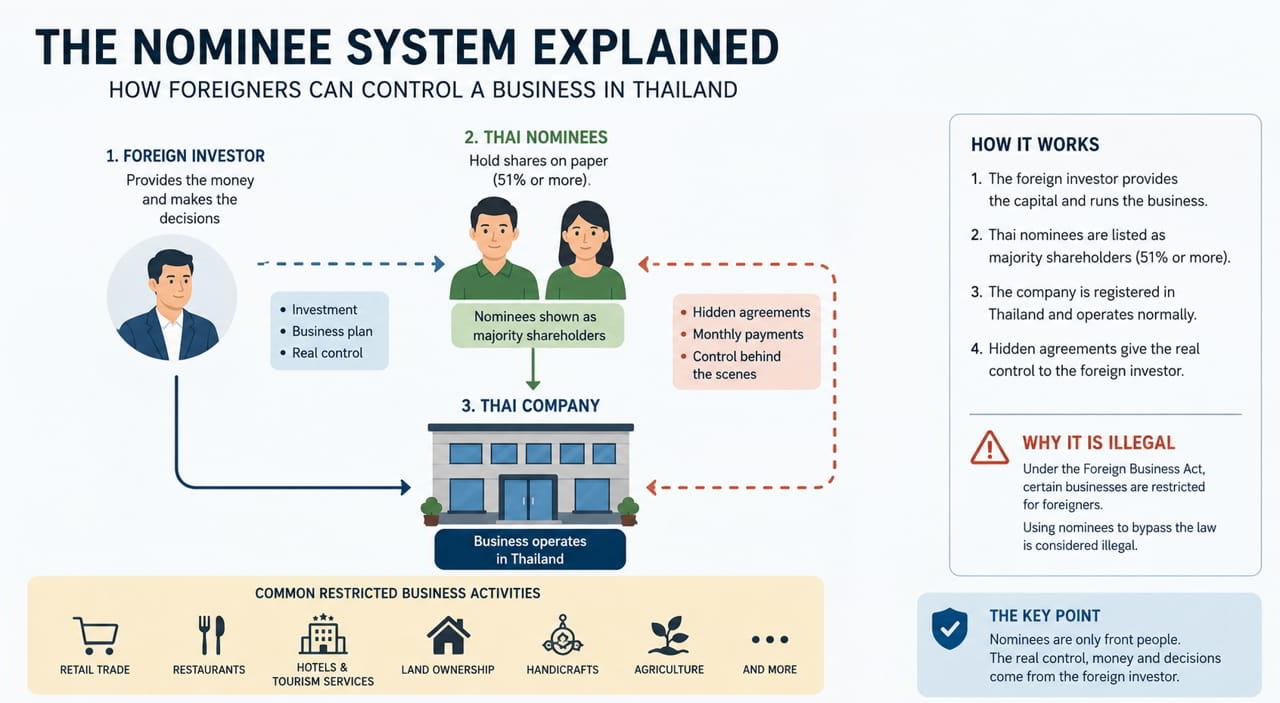
At the heart of the issue is the use of nominees — Thai proxy shareholders used by foreigners to indirectly control businesses restricted under Thai law.
In Thailand, several economic sectors remain protected under the Foreign Business Act. Foreigners cannot freely own certain types of businesses or land. To bypass these restrictions, some investors rely on Thai partners who officially hold the majority of shares while actual control remains in foreign hands.
For years, authorities largely tolerated these arrangements, especially in tourism-driven areas where foreign investment fueled economic growth. But the situation now appears to be changing.
Thailand’s Ministry of Commerce argues that nominee structures create economic imbalances, fuel property speculation and reduce opportunities for Thai entrepreneurs.
Authorities recently uncovered several high-profile cases:
- one Thai citizen listed as a shareholder in 87 different companies;
- an accounting firm linked to 89 suspected shell companies;
- multiple luxury real estate projects suspected of tax evasion and illegal land use.
The government now openly describes these activities as economic crimes.
Why Phuket, Koh Samui and Koh Phangan are being targeted
The three islands concentrate several issues that have become increasingly sensitive for Bangkok:
- booming international tourism;
- rising property prices;
- massive foreign investment inflows;
- growing numbers of businesses indirectly controlled by non-Thai nationals.
On Koh Phangan, the economy built around Full Moon Parties, yoga retreats, wellness tourism and expatriate communities has accelerated this transformation. Phuket, meanwhile, has attracted Russian, Chinese and European investors for years in sectors ranging from hospitality to restaurants and real estate.
Following the Covid-19 pandemic, Thai authorities also sought tighter control over financial flows and business ownership structures. The rapid tourism rebound reignited concerns over speculation and foreign influence in areas now highly dependent on international capital.
The issue is also politically sensitive. In several tourist regions, some locals argue that Thai people are increasingly becoming employees rather than business owners in their own communities.
Between foreign investment and national control
Thailand remains deeply dependent on international tourism and foreign investment. Authorities are not seeking to completely shut out foreign entrepreneurs. Instead, Bangkok says it wants to distinguish legal foreign investment from opaque or fraudulent business structures.
The government itself admits that, for years, business registration was prioritized over strict enforcement. Today, however, inspections are increasing and several cases have already been referred to anti-money laundering agencies and special investigation units.
For legally established expatriates, this new policy also creates uncertainty. Many argue that the development of these islands was made possible in part by foreign investment, especially in areas that were once economically marginal.
The debate therefore goes far beyond the legality of individual companies. It touches on the future economic model of Thailand’s tourist islands and the place foreign communities will occupy within local economies.
What is Thailand’s Foreign Business Act?
Adopted in 1999, Thailand’s Foreign Business Act (FBA) regulates which economic activities are accessible to foreigners.
The law restricts or prohibits majority foreign ownership in sectors considered strategic or sensitive for the national economy. Several industries remain partially protected:
- retail trade;
- restaurants;
- tourism services;
- land ownership;
- handicrafts;
- agriculture;
- selected service industries.
To bypass these restrictions, some investors rely on mixed companies using Thai shareholders as nominees — a practice considered illegal when it conceals actual foreign control.
Thai authorities say the current crackdown aims to distinguish legitimate foreign investment from opaque or fraudulent corporate structures.
FAQ
Why is Thailand investigating foreign-owned businesses?
Thai authorities are targeting companies suspected of using nominee shareholders to bypass restrictions imposed on foreign investors.
What is a nominee in Thailand?
A nominee is a Thai shareholder used as a proxy to allow a foreigner to indirectly control a company or land assets.
Which nationalities are most present in Koh Samui and Koh Phangan?
Thai authorities mainly cite French, British, Russian, Israeli and Chinese investors.
Can foreigners legally own businesses in Thailand?
Yes, but several sectors remain restricted under Thai law. Many foreign entrepreneurs therefore operate through joint structures or specialized legal arrangements.
Why are Phuket and Koh Phangan under particular scrutiny?
These islands concentrate large amounts of foreign investment linked to tourism, hospitality, restaurants and real estate.