

Air Pollution in Thailand: Bangkok and 45 Provinces on PM2.5 Alert
Written by the editors of theo-courant.com, your reference guide to Thailand and South-East Asia - based in Bangkok, at the heart of Thai culture.

Bangkok and large parts of Thailand are facing a new and prolonged episode of air pollution, with PM2.5 levels well above health safety thresholds. Authorities warn that unhealthy air conditions could persist until January 23, forcing travelers to adapt their plans and closely monitor air quality.
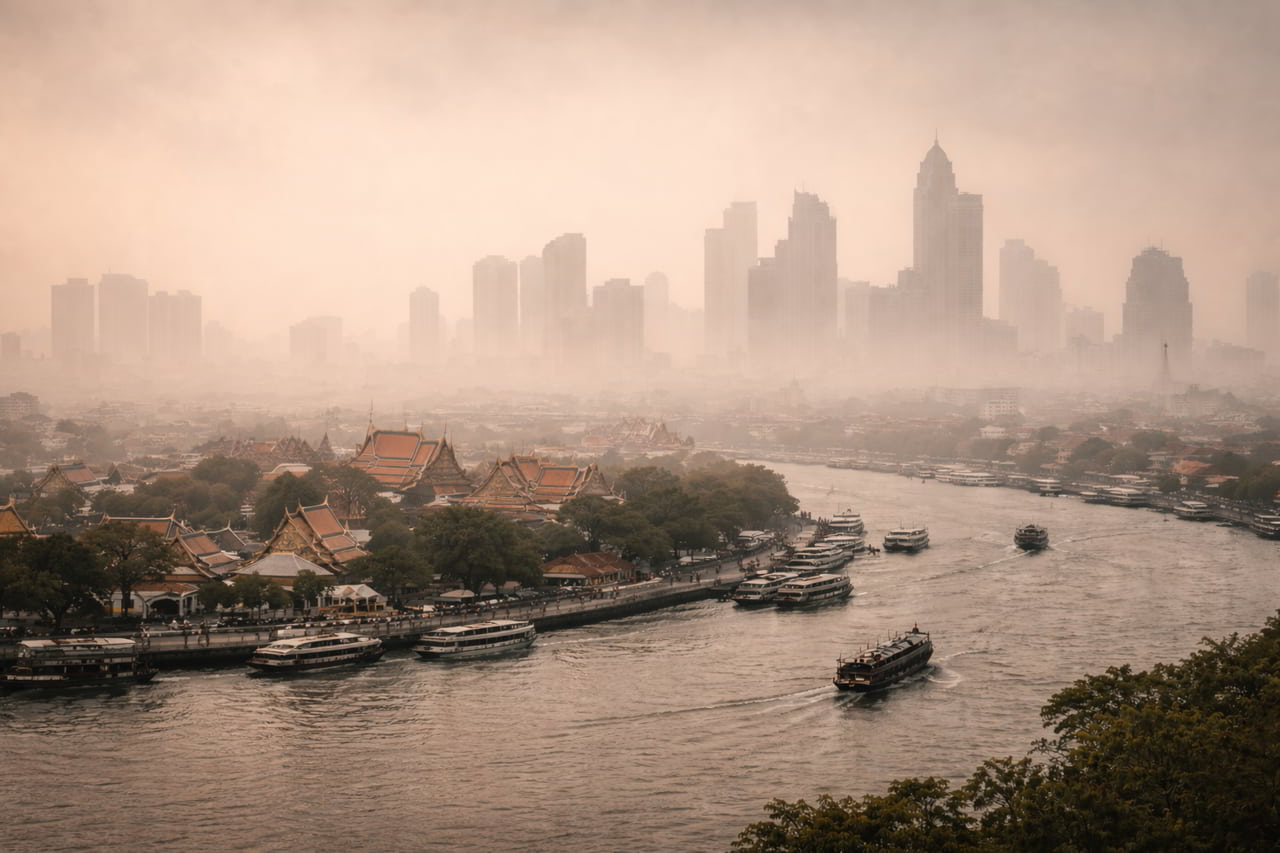
Dense smog over Bangkok and much of the country
A thick haze continues to blanket Bangkok and many regions nationwide. According to Thailand’s Pollution Control Department, 45 provinces are currently experiencing PM2.5 concentrations exceeding national safety standards.
Over a 24-hour average, measured levels ranged from 7.4 to 89.1 µg/m³, while the official safety limit is set at 37.5 µg/m³. In several urban and industrial areas, pollution levels are therefore more than double what is considered acceptable for public health.
Bangkok and surrounding provinces among the most affected
Bangkok and neighboring provinces — Nonthaburi, Pathum Thani and Samut Prakan — continue to record widespread unhealthy air. A red-zone area classified as hazardous to health was identified in Bang Phut subdistrict, in Muang Nonthaburi, highlighting particularly severe conditions north of the capital.
This situation reflects a combination of stagnant atmospheric conditions, traffic emissions and industrial activity, which regularly intensify pollution during the dry season.
Severe pollution peaks reported in other regions
The pollution is not limited to the capital. The highest PM2.5 concentration in the country was recorded in Mueang district, Nong Khai province, in northeastern Thailand.
Additional red-zone areas harmful to health were also identified in Ayutthaya and Saraburi, confirming that this pollution episode affects multiple regions.
By contrast, southern provinces remain relatively unaffected, a recurring pattern during seasonal haze events.
7-day PM2.5 forecast (January 17–23)
According to the Pollution Control Department’s seven-day forecast, PM2.5 levels are expected to increase further between January 17 and 23 across Bangkok, the North, Northeast, Central, Eastern and Western regions.
Only the southern part of the country is likely to remain largely unaffected.
Authorities report limited atmospheric dispersion, despite ongoing cloud-seeding and air-dispersion flights conducted since December by Aeronautical Radio of Thailand (Aerothai).
Sources and real-time monitoring:
- Pollution Control Department (PCD) – Air Pollution Problem Communication Center
- IQAir – Thailand air quality forecasts
- AQICN – Global air pollution map
What this means for travelers in Thailand
For travelers, this new wave of pollution confirms that air quality has become a seasonal concern in Thailand. Prolonged exposure to PM2.5 can cause respiratory irritation, headaches, fatigue and can worsen existing cardiovascular or pulmonary conditions.
During periods of high pollution, travelers are advised to limit outdoor activities, avoid intense physical exertion and wear N95 or equivalent masks when moving around urban areas. Vulnerable travelers — including children, elderly people and those with asthma — should take extra precautions or consider destinations less exposed to pollution.
How to monitor air quality in Thailand
Official data from the Pollution Control Department provide nationwide updates, while independent platforms such as IQAir and AQICN offer detailed maps, hourly data and short-term forecasts.
For travelers, checking air quality has become almost as essential as checking the weather before planning sightseeing or outdoor activities.
A structural issue still largely downplayed
Despite its growing health and tourism impact, air pollution remains a low political priority in Thailand. Measures are often reactive and temporary, with little long-term structural strategy.
As Bangkok and popular destinations increasingly appear on global pollution rankings, the risk is clear: more travelers may choose to avoid Thailand during the dry season. Ignoring this environmental challenge could ultimately prove more costly than addressing it seriously.