


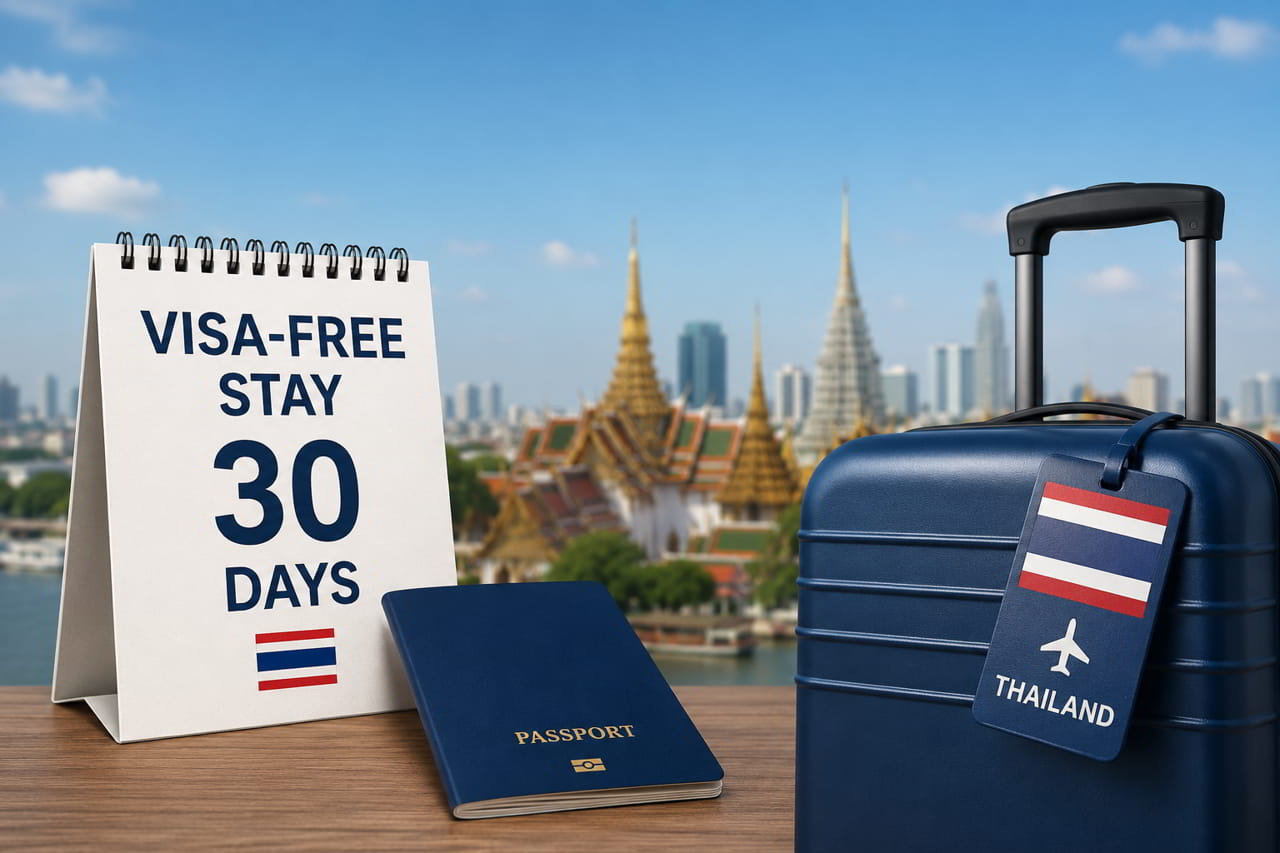
Thailand Confirms Return to 30-Day Visa-Free Stay for 93 Countries
Written by the editors of theo-courant.com, your reference guide to Thailand and South-East Asia - based in Bangkok, at the heart of Thai culture.

Thailand has reinstated a 30-day visa-free entry limit for nationals of 93 countries in 2026. The decision has been officially validated and is now awaiting publication in the Royal Gazette, the final step before it comes into force.
Thailand ends the 60-day visa-free stay
Thailand will officially end the 60-day visa-free scheme introduced in July 2024 for travelers from 93 countries. The Thai government has confirmed a return to a 30-day visa-free stay.
The measure is now pending publication in the Royal Gazette, which is the final administrative step before enforcement.
This change marks a major shift for tourists, long-stay travelers, remote workers, and seasonal visitors in Thailand.
Official reasons for reducing the visa-free stay
According to Thai authorities, the 60-day visa-free policy led to a rise in misuse, including:
- Illegal employment
- Undeclared business activities
- Remote work under tourist status
- Frequent “visa runs”
- Fraud-related activities
Officials also stated that most tourists stay less than 30 days, making the extended allowance unnecessary for standard tourism purposes.
The policy is also aligned with a broader strategy to encourage the use of proper visa categories such as tourist visas, retirement visas, and the DTV (Destination Thailand Visa).
93 countries affected by the new visa-free rule
The 30-day visa-free entry policy applies to a total of 93 countries under Thailand’s expanded visa exemption scheme. This includes most European nations as well as key long-haul markets such as the United States, Canada, the United Kingdom, Australia, New Zealand, Japan, South Korea, and several Southeast Asian countries. The measure is part of Thailand’s broader effort to standardize entry conditions while tightening control over long-stay tourist stays and non-tourism activities conducted under visa-free status.
The 30-day rule is expected to come into effect shortly after publication in the Royal Gazette. Travelers planning trips for summer 2026 or the upcoming high season should closely monitor official updates.
Who will be most affected by the change?
This policy shift will primarily impact:
- Long-stay winter travelers
- Digital nomads and remote workers
- Backpackers traveling across Southeast Asia
- Part-time expatriates
- Multi-country travelers in the region
Visa runs specifically targeted
The reform directly targets the widespread use of “visa runs,” where travelers exit Thailand briefly to re-enter and reset their visa-free period.
Since the extension to 60 days in 2024, visa runs had become increasingly common across:
- Laos
- Cambodia
- Malaysia
- Vietnam
Thai authorities now aim to reduce this practice and strengthen land border controls.
TDAC remains mandatory
The Thailand Digital Arrival Card (TDAC) remains mandatory for all foreign visitors, even after the visa-free duration change.
Since 2026, travelers must complete this digital form before entering Thailand.
TDAC required information
| Information | Mandatory |
|---|---|
| Passport details | Yes |
| Accommodation in Thailand | Yes |
| Flight information | Yes |
| Personal contact details | Yes |
| Health declaration (if required) | Depending on situation |
Visa options for longer stays in Thailand
Tourist Visa (TR)
The standard tourist visa remains the simplest option for longer stays.
It typically allows:
- 60-day initial stay
- 30-day extension
- Up to 90 days total stay
DTV (Destination Thailand Visa)
Thailand is also promoting the DTV for:
- Digital nomads
- Freelancers
- Remote workers
This visa provides longer stays and greater administrative stability for remote professionals.
Impact on Thailand’s tourism sector
The reduction of the visa-free stay may influence travel behavior among European and international visitors.
Fewer long stays expected
Travelers who previously stayed one to two months may shorten their trips or choose alternative destinations in Southeast Asia.
Shift toward regulated tourism
Thailand appears to be prioritizing:
- Long-term retirees
- High-spending tourists
- Investors
- Official remote workers with proper visas
What travelers should check before departure
| Requirement | Status |
|---|---|
| Passport validity | Minimum 6 months |
| Return ticket | Often required |
| TDAC form | Mandatory |
| Allowed stay duration | Reduced to 30 days |
| Travel insurance | Strongly recommended |
Official confirmation pending publication
The reform has already been validated by Thai authorities. It will enter into force once published in the Royal Gazette, the final legal step before implementation.
For many European and international travelers, this marks the end of a particularly flexible era for long-stay tourism in Thailand.
FAQ: Thailand new entry rules
Has Thailand officially ended the 60-day visa-free stay?
Yes. The Thai government has confirmed a return to a 30-day visa-free policy. It is now awaiting publication in the Royal Gazette.
Can travelers still extend their stay?
Yes. A 30-day extension at Thai immigration is generally still possible.
Is the TDAC form mandatory?
Yes. All foreign travelers must complete the Thailand Digital Arrival Card before arrival.
Will visa runs become more difficult?
Yes. Authorities are strengthening border controls to limit repeated tourist entries.
Which visa should be used for long stays?
The Tourist Visa (TR), DTV visa, or long-term visa options remain the most suitable depending on the traveler’s profile.