


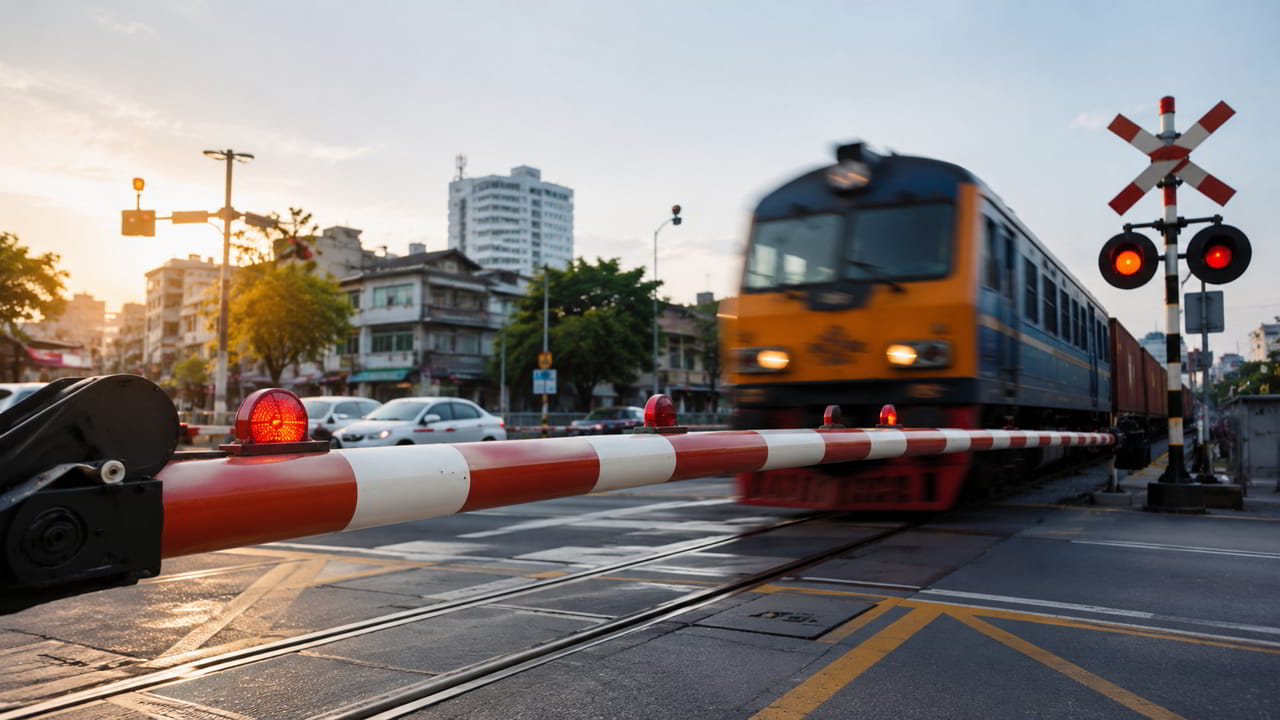
Bangkok Train-Bus Crash: What Happened, Why It Matters and Thailand’s New Safety Measures
Written by the editors of theo-courant.com, your reference guide to Thailand and South-East Asia - based in Bangkok, at the heart of Thai culture.

A deadly collision between a freight train and a public bus in Bangkok has once again raised serious questions about railway crossing safety in Thailand. The crash, which happened near Makkasan in central Bangkok, left eight people dead and dozens injured, prompting the Thai government to announce urgent safety measures.
A deadly collision near Makkasan in Bangkok
The accident occurred on May 16, 2026, close to Makkasan station, near the rail connection to Suvarnabhumi Airport. A freight train slammed into a city bus that had become trapped on the tracks while traffic was backed up at a nearby intersection.
The impact triggered a major fire. The bus was dragged several meters along the tracks while nearby motorcycles and cars were also caught in the collision. Emergency services rushed to the scene to extinguish the flames and rescue injured passengers.
The preliminary death toll stands at eight fatalities and more than thirty injuries. All of the victims who died were passengers on the bus.
Why was the bus stuck on the railway tracks?
According to the first findings released by Thai authorities, the bus became immobilized on the tracks because of heavy traffic congestion and a red traffic light positioned immediately after the level crossing.
This type of road layout is common in Bangkok, where railway crossings are sometimes located only a few meters away from busy intersections. During rush hour, vehicles can end up trapped on the tracks with no room to move forward.
Witnesses also claimed that the automatic crossing barriers may not have lowered properly before the train arrived. Investigators are now examining whether a technical malfunction contributed to the disaster.
Train driver reportedly tested positive for drugs
The investigation took another turn after Thai media reported that the train driver allegedly tested positive for narcotics following the crash.
Authorities also stated that the driver may not have possessed the full operational certifications required for this type of railway service, according to preliminary administrative checks cited by local media.
The train driver has since been charged with negligence causing death. The bus driver is also expected to face legal action once his medical condition allows investigators to question him.
Thailand’s prime minister promises railway crossing reforms
Following the tragedy, the Thai government announced a series of measures aimed at improving railway safety across the country.
The proposed measures include:
Upgrading automatic barrier systems
Several railway crossings in Thailand still rely on outdated or partially automated systems. Nationwide inspections have been ordered after the accident.
Increasing drug and safety checks for drivers
Authorities plan to expand drug testing for train operators as well as bus and truck drivers.
Redesigning dangerous intersections
The Ministry of Transport is considering modifications to crossings located near heavily congested intersections where vehicles can easily become trapped.
Building more bridges and underpasses
In the longer term, Bangkok authorities want to gradually replace some level crossings with bridges or tunnels separating road and rail traffic entirely.
Why railway crossings remain dangerous in Thailand
Thailand still has a large number of open railway crossings, including in densely populated urban areas.
Infrastructure problems are only part of the issue. Driver behavior also plays a major role:
- crossing despite warning signals;
- traffic congestion blocking the tracks;
- excessive speed;
- poor lane discipline;
- limited enforcement in some areas.
Thailand regularly ranks among the countries with the world’s highest road fatality rates, according to international safety reports.
Previous railway accidents that shocked Thailand
The Makkasan disaster is far from an isolated case.
The Chachoengsao train-bus collision in 2020
In October 2020, a train struck a bus carrying passengers to a temple in Chachoengsao province. Nineteen people were killed in one of Thailand’s deadliest railway crossing accidents.
The tragedy already exposed serious concerns about unprotected railway crossings and poor traffic management.
The Sikhio railway disaster in 2026
Earlier in January 2026, another major railway disaster occurred in Nakhon Ratchasima province when a construction crane collapsed onto a passenger train. More than thirty people lost their lives.
Investigators later pointed to multiple safety violations during railway construction work.
These repeated accidents continue to fuel criticism of Thailand’s transportation safety standards and infrastructure management.
What travelers and expatriates should know
For foreign visitors and expatriates living in Thailand, the accident serves as another reminder of the country’s transportation risks.
Traffic jams can quickly become dangerous
In Bangkok, it is not unusual for vehicles to become stuck in intersections or on railway tracks during peak traffic periods.
Traffic rules are not always respected
Even when warning lights flash or barriers begin to close, some drivers still attempt to cross.
Land transportation risks remain higher than in Europe
Serious road and rail accidents remain relatively common in Thailand, especially in heavily congested urban environments.
FAQ – Bangkok train crash
Where did the Bangkok train-bus crash happen?
The collision occurred near Makkasan station in central Bangkok, close to the airport rail link to Suvarnabhumi Airport.
How many people died in the accident?
The provisional official death toll is eight people, with more than thirty others injured.
Why was the bus trapped on the tracks?
The bus reportedly became stuck because of heavy traffic congestion and a nearby red light immediately after the crossing.
Did the train driver test positive for drugs?
According to several Thai media reports, the train driver allegedly tested positive for narcotics after the accident.
Has Thailand experienced similar railway accidents before?
Yes. Major railway accidents in recent years include the 2020 Chachoengsao train-bus collision and the 2026 Sikhio railway disaster.