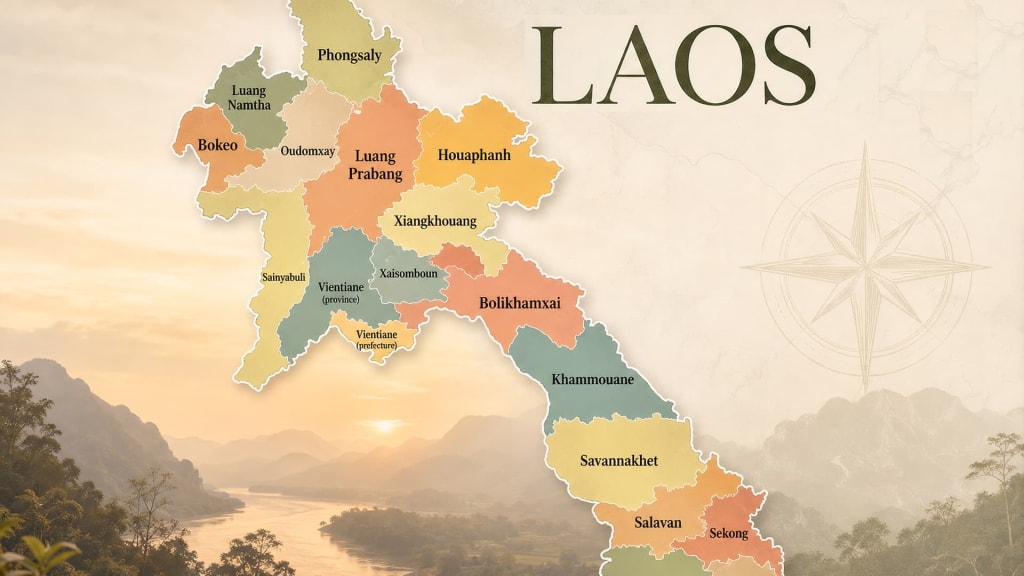


Regions of Laos: Landscapes, Nature and Places to Explore
From the mountainous north to the Mekong plains, via the central limestone karsts and the southern plateaus, Laos has a remarkably varied landscape. Distances, terrain and transport conditions all have a major influence on how visitors experience the country.
Rather than focusing solely on cities and major tourist attractions, exploring Laos by region offers a better understanding of its landscapes, agricultural activities, communities and natural environments. Each area has its own distinctive character and may deserve several days to explore.
This section brings together our guides to the different regions of Laos, with information to help you understand what makes each area special and plan your trip.
Understanding the main regions of Laos
Laos is a landlocked country in Southeast Asia, bordered by Thailand, Vietnam, Cambodia, China and Myanmar. The Mekong is one of its main geographical features, particularly along the country’s western border.
The terrain can be divided into several broad areas: the mountains of the north, the plateaus and mountain ranges of the east, and the plains and river valleys. These differences are reflected in the landscapes, farming practices, ways of life and opportunities for exploration.
The regions featured on this page are geographical and tourism areas. They do not necessarily correspond to administrative provincial boundaries: a natural region or travel itinerary may extend across several provinces.
Regions of Laos to explore
The Bolaven Plateau
Located in southern Laos, the Bolaven Plateau is known for its coffee plantations, waterfalls, farmland and generally cooler temperatures than the surrounding lowlands. It extends across several southern provinces.
The area is well suited to exploring landscapes and agricultural activities, as well as travelling by road. It is a region well worth discovering.
The Champasak region
In southern Laos, the Champasak region brings together the Mekong, agricultural land and an important historical heritage. It offers an opportunity to explore the area’s ancient history, river landscapes and territories stretching towards the south of the country.
This section will focus on the region as a whole, complementing articles dedicated to individual towns and specific sites.
[Champasak region guide — coming soon]
Thakhek and the karst landscapes of Khammouane
In central Laos, the area around Thakhek and Khammouane Province is characterised by limestone formations, caves, valleys and striking karst landscapes. These features form one of the central region’s distinctive natural environments.
The area is well suited to exploring geological sites, roads winding through limestone scenery and rural areas away from the main urban centres.
[Thakhek and Khammouane guide — coming soon]
More regions to explore
This section will gradually expand to cover other parts of Laos, including the mountainous north, the Annamite landscapes in the east, the Mekong valleys and the natural areas of the south.
Each new page will introduce the distinctive features of a region and link to more detailed guides covering activities, natural sites, villages, transport and accommodation options.
Nature, agriculture and cultural diversity
The landscapes of Laos are closely linked to the activities of its people. Rice cultivation plays an important role in the plains and valleys, while other crops are grown according to altitude and local conditions. Coffee, for example, is particularly associated with the Bolaven Plateau.
The country is also home to a wide range of communities. Laos officially recognises 49 ethnic groups, divided into four major ethnolinguistic families. Their languages, traditions and ways of life contribute to the country’s cultural diversity.
Natural environments are equally varied, ranging from tropical forests, mountains and plateaus to wetlands, rivers and limestone landscapes. Several protected areas help preserve this biodiversity, although access and permitted activities vary from one site to another.
Planning a trip through the regions of Laos
Travel conditions vary considerably from one area to another. Main roads connect the country’s major routes, but reaching some rural or mountainous areas takes more time. The rainy season can also affect road conditions and access to certain sites.
When planning a trip, it is worth considering distances, available time, transport options and the type of experience you are looking for. Some regions can be explored during a short stop of a few days, while others deserve a longer stay to discover their landscapes and villages.